


Commercial Exit Devices Comparison: Top Brands & Models Reviewed
Posted by ZenSupply Locksmith Desk on Jun 11th 2026
TL;DR — Quick Pick
- Von Duprin 98/99 Series: Industry standard for high-traffic applications — Grade 1 per A156.3 (1,000,000 cycles minimum), widest trim compatibility
- Sargent 80 Series: Best for institutional projects requiring UL-listed fire assemblies — 8888 rim, 8810 mortise, 8888-F fire-rated trim
- Yale 7000 Series: Value option for medium-traffic openings — Grade 1 certified, Assa Abloy quality at 15-20% below Von Duprin list
- Falcon 25 Series: Budget-conscious choice for light commercial — Grade 2 per A156.3 (500,000 cycles minimum), Allegion brand
- Detex ECL-230X: Alarmed exit control for delayed egress and perimeter security — integrated alarm, field-adjustable delay
What Are the Best Commercial Exit Device Brands?
The commercial exit device market splits into three tiers. Von Duprin (Allegion) and Sargent (Assa Abloy) dominate institutional and high-traffic applications. Both meet Grade 1 per A156.3 — 1,000,000 cycles minimum operational life. Yale (Assa Abloy) and Falcon (Allegion) target mid-tier commercial projects. Detex specializes in alarmed exit control and delayed egress.
Von Duprin holds the largest installed base in North America. The 98/99 series ships with touchbar or crossbar configurations. Rim devices (98 series) suit hollow metal and wood doors. Vertical rod devices (99 series) handle pairs and narrow stile aluminum. Trim options include 9947EO and 9975EO fire-rated lever sets for UL 10C-rated assemblies. Von Duprin devices integrate with Von Duprin QEL and EL electrified trim for access control.
Sargent 80 series competes directly with Von Duprin in institutional markets. The 8888 rim device and 8810 mortise exit device share the same 1,000,000-cycle Grade 1 rating. Sargent's 8888-F fire-rated trim meets UL 10C requirements for 3-hour assemblies. Architects specify Sargent when keying matches existing Sargent mortise lock systems.
Yale 7000 series offers Grade 1 performance at reduced cost. List pricing typically runs 15-20% below Von Duprin equivalents. The trade-off: narrower trim selection and longer lead times for electrified options. Yale devices work well for office buildings and retail where budget matters but Grade 1 certification remains mandatory.
How Do Rim Exit Devices Compare to Vertical Rod Exit Devices?

Rim devices latch into a strike mounted on the frame. Vertical rod devices extend rods into the head and threshold. The choice depends on door construction, fire rating requirements, and pair coordination needs.
Rim panic exit devices suit single hollow metal and wood doors. Installation requires 2-1/8" backset prep for the latchbolt. Rim devices cost 20-30% less than vertical rod equivalents. They ship faster — most distributors stock Von Duprin 98 and Sargent 8888 rim devices in common finishes. Rim devices cannot coordinate pairs without auxiliary vertical rods or overlapping astragals.
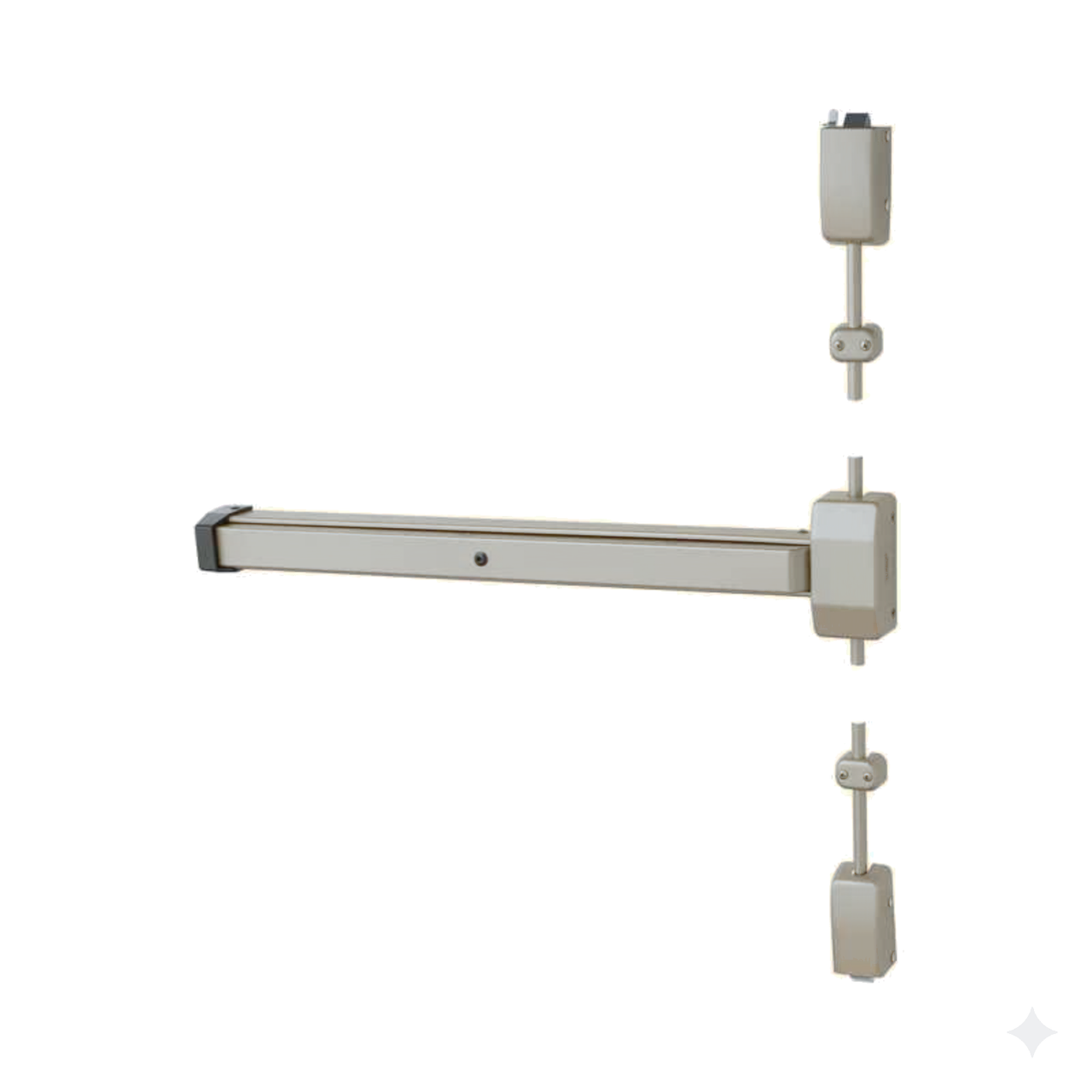
Vertical rod devices solve pair coordination and narrow stile applications. Surface vertical rod exit devices mount rods externally — acceptable for most commercial openings. Concealed vertical rod exit devices hide rods inside the door — required for high-end architectural projects and some fire-rated pairs. Concealed rods add 40-60% to device cost and require factory prep or field modification.
Fire ratings affect device selection. UL 10C-rated assemblies permit both rim and vertical rod devices. NFPA 80 prohibits dogging (mechanical hold-open) on fire-rated exit devices. Electromagnetic hold-opens with fire alarm release remain compliant. Vertical rod devices provide better pair coordination on fire-rated openings — both leaves latch into frame without center mullions.
What Is the Difference Between Von Duprin and Sargent Exit Devices?
Von Duprin and Sargent both manufacture Grade 1 exit devices meeting A156.3 standards. The differences emerge in trim compatibility, electrification options, and corporate ecosystems.
Von Duprin 98/99 series dominates new construction. Trim options span 9947EO (exit-only lever), 9975EO (passage lever), and QEL/EL electrified trim. QEL integrates electric latch retraction — pair with HES or Securitron strikes for access control. Von Duprin devices coordinate with Allegion's LCN closers and Schlage locks. Specify Von Duprin when the project uses Allegion hardware throughout.
Sargent 80 series (8888 rim, 8810 mortise) suits retrofit and institutional projects. Sargent trim matches existing mortise lock aesthetics — important for hospitals and universities with decades-old Sargent systems. The 8888-F fire-rated trim ships with 3-hour UL listings. Sargent devices integrate with Assa Abloy access platforms — pair with Corbin Russwin locks and Norton closers for single-source responsibility.
Electrification differs between brands. Von Duprin QEL uses solenoid-driven latch retraction. Sargent 80 series accepts motor-driven electrified trim. Both approaches work — QEL responds faster (under 1 second), Sargent motor trim draws less current. Choose based on existing access control infrastructure and power budget.
Pricing runs parallel. Von Duprin and Sargent list within 5% of each other for equivalent configurations. Expect 30-40% off list for project quantities (10+ devices). Lead times favor Von Duprin — stock devices ship in 2-3 days, Sargent custom configurations take 4-6 weeks.
Which Exit Device Is Best for High-Traffic Applications?
High-traffic openings (100+ actuations per day) require Grade 1 devices. Von Duprin 98/99, Sargent 80, and Yale 7000 all meet the 1,000,000-cycle minimum per A156.3. Device selection depends on door type, trim requirements, and maintenance access.
Von Duprin 98 series handles the highest traffic volumes. Schools, hospitals, and transit facilities run Von Duprin devices past 2,000,000 cycles with routine maintenance. The touchbar mechanism tolerates abuse better than crossbar designs. Replacement parts ship from stock — critical for 24/7 facilities. Pair Von Duprin devices with LCN 4040XP closers for coordinated high-cycle performance.
Mortise panic exit devices suit high-security applications. Sargent 8810 mortise exit combines panic hardware with mortise lock security. The mortise chassis provides anti-pry resistance — specify for exterior doors and psychiatric facilities. Mortise devices cost 50-70% more than rim equivalents but eliminate separate lock installation.
Maintenance intervals matter for high-traffic devices. Grade 1 devices require annual inspection per manufacturer guidelines. Lubricate pivot points with dry PTFE spray — never oil-based lubricants that attract dust. Replace touchbar springs every 500,000 cycles. Budget $150-200 per device for annual preventive maintenance contracts.
Electrified devices in high-traffic applications need dedicated power. QEL and motor-driven trim draw 0.5-1.5A during actuation. Size power supplies for simultaneous actuation of all devices on the circuit. Pair electrified exit devices with fail-safe electric strikes — power loss allows free egress per life safety codes.
How Much Do Commercial Exit Devices Cost by Brand?
List pricing for commercial exit devices and panic bars varies by configuration. Rim devices start lower than vertical rod. Electrified trim adds 40-60%. Fire-rated trim adds 15-25%. Expect project discounts of 30-40% off list for quantities above 10 units.
Von Duprin 98 rim device (touchbar, non-electrified): list pricing typically $450-550. Add $200-300 for 9947EO fire-rated trim. QEL electrified trim adds $350-450. Von Duprin 99 surface vertical rod: list pricing typically $650-800. Concealed vertical rod (CVR) configurations run $900-1,200 list. Von Duprin holds pricing firm — minimal variation between distributors.
Sargent 8888 rim device: list pricing typically $425-525, running 5-10% below Von Duprin equivalents. Sargent 8888-F fire-rated trim adds $180-250. Sargent 8810 mortise exit device: list pricing typically $850-1,050. Sargent offers deeper project discounts than Von Duprin — negotiate 35-45% off list for institutional contracts.
Yale commercial hardware 7000 series undercuts Von Duprin by 15-20%. Yale 7100 rim device: list pricing typically $375-475. Yale vertical rod devices run $550-700 list. The savings come with trade-offs — longer lead times (4-6 weeks vs. 2-3 days) and narrower trim selection. Yale makes sense for budget-conscious projects accepting extended schedules.
Falcon 25 series targets light commercial applications. Falcon 25 rim device: list pricing typically $275-350. Grade 2 per A156.3 (500,000 cycles minimum) suits office buildings and retail with moderate traffic. Falcon devices ship from Allegion's distribution network — same lead times as Von Duprin. Specify Falcon when Grade 1 certification isn't mandatory and budget drives decisions.
Detex ECL-230X alarmed exit device: list pricing typically $650-850 for basic configuration. Add $200-300 for delayed egress timer. Detex specializes in perimeter security — the ECL-230X integrates local alarm with optional delayed egress (15-30 second adjustable delay). Pair with fire alarm systems for compliant delayed egress per IBC and NFPA 101.
What Are the Key Features to Compare in Exit Devices?
Exit device selection requires evaluating cycle rating, trim compatibility, electrification options, fire ratings, and ADA compliance. Start with ANSI/BHMA grade — Grade 1 for high traffic, Grade 2 for light commercial.
Cycle rating determines operational life. Grade 1 per A156.3 requires 1,000,000 cycles minimum. Grade 2 requires 500,000 cycles. Grade 3 requires 250,000 cycles. At 50 actuations per day, a Grade 1 device lasts 54+ years before reaching minimum test threshold. Manufacturers test beyond minimums — Von Duprin and Sargent devices routinely exceed 2,000,000 cycles in field installations. Don't confuse tested life with grade threshold.
Trim compatibility affects retrofit projects. Von Duprin 98/99 accepts the widest range of trim — 9947EO, 9975EO, QEL, EL. Sargent 80 series trim matches existing mortise lock aesthetics. Falcon exit devices use proprietary trim — verify compatibility before specifying. Trim backset matters — most exit devices use 2-1/8" backset, some institutional devices offer 2-3/4" for existing prep.
Electrification options split between mechanical and electronic. QEL and motor-driven trim provide electric latch retraction for access control. Electrified devices require 12-24VDC power — size supplies for peak current draw. Fail-safe operation (power loss = free egress) meets life safety requirements. Fail-secure operation (power loss = locked) violates egress codes except on perimeter doors with alternative exits.
Fire ratings require UL-listed devices in UL 10C-rated assemblies. Von Duprin 9947EO and Sargent 8888-F meet 3-hour fire ratings. NFPA 80 prohibits mechanical dogging on fire-rated devices. Electromagnetic hold-opens with fire alarm release remain compliant. Verify fire rating requirements before specifying — not all exit devices carry UL fire listings.
ADA compliance affects operating force. IBC and ADA Standards require 5 lbf maximum for interior doors. Exit devices ship with 3-5 lbf actuation force from factory. Pair with ADA-compliant closers (LCN 4040XP, Norton 8500 series) to maintain 5 lbf opening force. Exterior and fire-rated doors have no maximum force limit — focus on reliable operation over light touch.
Which Exit Device Brands Meet ANSI Grade 1 Standards?
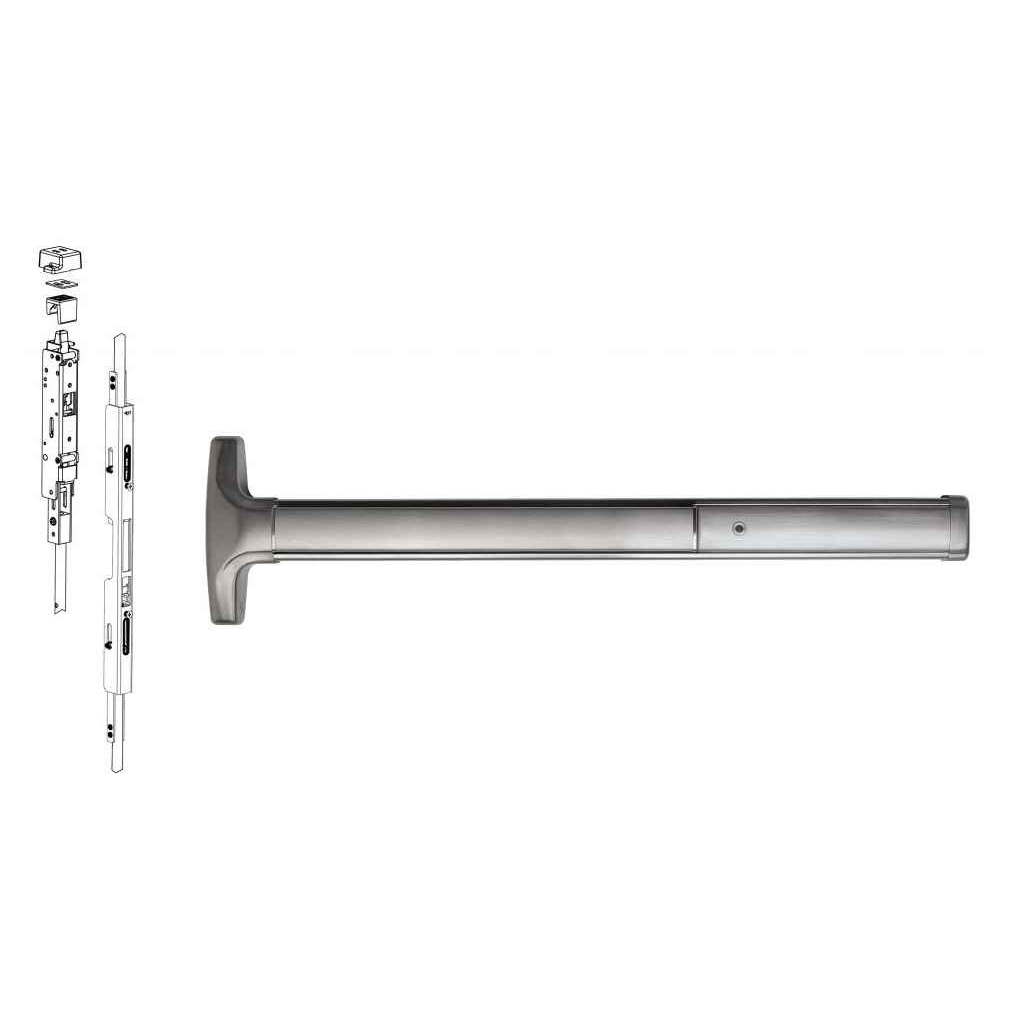
Von Duprin, Sargent, and Yale manufacture Grade 1 exit devices meeting A156.3 requirements. Grade 1 certification requires 1,000,000 cycles minimum operational life, 250 lbf end load resistance, and corrosion resistance testing. Verify current certifications — manufacturers update product lines and testing.
Von Duprin 98/99 series holds Grade 1 certification across all configurations. The 98 rim device and 99 vertical rod device share the same chassis and mechanism. Von Duprin maintains third-party testing through BHMA — certificates available on request. Specify Von Duprin when project specifications mandate Grade 1 and wide trim compatibility.
Sargent 80 series (8888 rim, 8810 mortise, 8888-F fire-rated) meets Grade 1 per A156.3. Sargent devices undergo testing at independent labs — UL and Intertek certifications verify compliance. The 8810 mortise exit device combines Grade 1 panic hardware with mortise lock security. Sargent suits institutional projects requiring both panic egress and high-security locking.
Yale 7000 series carries Grade 1 certification at reduced cost. Yale leverages Assa Abloy's manufacturing scale to deliver Grade 1 performance 15-20% below Von Duprin list pricing. The trade-off: narrower trim selection and longer lead times. Yale makes sense for projects where Grade 1 certification matters but budget constrains choices.
Falcon 25 series meets Grade 2 per A156.3 (500,000 cycles minimum) — not Grade 1. Falcon targets light commercial applications where Grade 1 isn't specified. The cost savings (30-40% below Von Duprin) suit office buildings and retail with moderate traffic. Don't specify Falcon for high-traffic or institutional projects requiring Grade 1.
Detex panic hardware focuses on alarmed exit control rather than Grade 1 mechanical devices. The ECL-230X meets Grade 1 cycle requirements but adds integrated alarm and delayed egress. Detex suits perimeter security applications — loading docks, emergency exits, and restricted areas. Pair Detex devices with fire alarm systems for code-compliant delayed egress.
How Do Touchbar and Crossbar Exit Devices Compare?
Touchbar and crossbar describe the actuating mechanism. Touchbars use a flat paddle spanning the door width. Crossbars use a cylindrical bar. Both meet A156.3 requirements — the choice affects aesthetics, durability, and user preference.
Touchbars dominate commercial installations. Von Duprin 98/99 series ships with touchbar as standard. The flat paddle distributes force across the entire bar — users can push anywhere along the width. Touchbars tolerate abuse better than crossbars — important for schools and transit facilities. Replacement touchbar covers cost $40-60 and install without tools. Specify touchbar for high-traffic applications and institutional projects.
Crossbars suit architectural projects prioritizing aesthetics. The cylindrical bar presents a cleaner profile than flat touchbars. Crossbars require more precise actuation — users must push the bar itself, not the surrounding area. This precision reduces accidental actuation in tight spaces. Crossbars cost 10-15% more than touchbar equivalents. Specify crossbar for corporate offices and upscale retail where appearance matters.
Actuation force remains identical between touchbar and crossbar — both ship with 3-5 lbf from factory. The difference emerges in perceived effort. Touchbars feel easier because users can push with their full hand or forearm. Crossbars require gripping or pushing the cylindrical bar. ADA compliance applies equally — both configurations meet 5 lbf maximum for interior doors when paired with compliant closers.
Maintenance differs slightly. Touchbar mechanisms use simpler pivot assemblies — fewer parts to fail. Crossbar mechanisms include additional bearings for rotational movement. Both designs exceed 1,000,000 cycles in Grade 1 testing. Field experience shows touchbars lasting longer in abusive environments — crossbars perform better in controlled-access settings.
Choose Von Duprin When:
- Project requires widest trim compatibility — 9947EO, 9975EO, QEL, EL options span all applications
- Fast delivery matters — stock devices ship in 2-3 days from Allegion distribution
- Coordinating with Allegion ecosystem — LCN closers, Schlage locks, Steelcraft frames
- High-traffic institutional applications — schools, hospitals, transit facilities with 100+ daily actuations
Choose Sargent When:
- Matching existing Sargent mortise lock systems — trim aesthetics coordinate across building
- Fire-rated assemblies require UL 10C listings — 8888-F meets 3-hour requirements
- Institutional projects demand Assa Abloy single-source — Corbin Russwin locks, Norton closers, Sargent exits
- Mortise exit devices needed — 8810 combines panic hardware with mortise lock security
Choose Yale When:
- Budget constraints require Grade 1 performance at reduced cost — 15-20% below Von Duprin list
- Extended lead times acceptable — 4-6 weeks vs. 2-3 days for stock configurations
- Office buildings and retail with moderate traffic — Grade 1 certification without premium pricing
- Assa Abloy ecosystem preferred but Sargent pricing too high — Yale splits the difference
| Brand/Series | BHMA Grade | Cycle Rating | Best For | List Price Tier |
|---|---|---|---|---|
| Von Duprin 98/99 | Grade 1 | 1,000,000 minimum per A156.3 | High-traffic institutional, widest trim compatibility | $450-800 (rim), $650-1,200 (vertical rod) |
| Sargent 80 Series | Grade 1 | 1,000,000 minimum per A156.3 | Fire-rated assemblies, mortise exit applications | $425-750 (rim), $850-1,050 (mortise) |
| Yale 7000 Series | Grade 1 | 1,000,000 minimum per A156.3 | Budget-conscious Grade 1 projects | $375-700 (15-20% below Von Duprin) |
| Falcon 25 Series | Grade 2 | 500,000 minimum per A156.3 | Light commercial, office buildings | $275-450 (30-40% below Von Duprin) |
| Detex ECL-230X | Grade 1 | 1,000,000 minimum per A156.3 | Alarmed exit control, delayed egress | $650-1,150 (with alarm/delay options) |
Need exit devices now? Browse our commercial exit devices inventory — Grade 1 devices from Von Duprin, Sargent, and Yale ship in 2-3 days.
How Von Duprin Compares to Sargent and Yale
Von Duprin, Sargent, and Yale compete in overlapping segments with distinct advantages. Von Duprin leads in trim variety and distribution reach. Sargent dominates institutional retrofits and fire-rated applications. Yale undercuts both on price while maintaining Grade 1 certification.
Trim compatibility separates Von Duprin from competitors. The 98/99 series accepts 9947EO exit-only, 9975EO passage, QEL electrified, and EL motorized trim. This range covers every application from basic panic egress to integrated access control. Sargent 80 series offers fewer trim options but matches existing mortise lock aesthetics — critical for retrofit projects. Yale 7000 series provides basic trim configurations at reduced cost — adequate for new construction but limiting for complex access control.
Fire ratings favor Sargent in institutional markets. The 8888-F fire-rated trim meets UL 10C requirements for 3-hour assemblies. Von Duprin 9947EO and 9975EO also carry UL fire listings but Sargent's institutional presence gives it specification advantage. Yale 7000 series includes fire-rated options but longer lead times (6-8 weeks for fire trim vs. 2-3 weeks for Von Duprin) limit emergency replacement scenarios.
Electrification approaches differ between brands. Von Duprin QEL uses solenoid-driven latch retraction — fast response (under 1 second) but higher current draw (1.2-1.5A). Sargent motor-driven trim draws less current (0.5-0.8A) but responds slower (1-2 seconds). Yale electrified trim follows Assa Abloy's motor-driven approach. Choose based on access control response requirements and power supply capacity.
Pricing creates clear tiers. Von Duprin commands premium pricing — justified by widest trim selection and fastest delivery. Sargent runs 5-10% below Von Duprin list but offers deeper project discounts (35-45% vs. 30-40%). Yale undercuts both by 15-20% on list pricing — the trade-off comes in lead times and trim limitations. For projects prioritizing cost over speed, Yale delivers Grade 1 performance at Grade 2 pricing.
Corporate ecosystems influence specification decisions. Von Duprin integrates with Allegion's LCN closers, Schlage locks, and Steelcraft frames — single-source responsibility for door openings. Sargent coordinates with Assa Abloy's Corbin Russwin locks and Norton closers. Yale shares Assa Abloy parentage with Sargent but operates as value brand — less integration support than Sargent's institutional focus. Specify based on existing building systems and preferred vendor relationships.
Ready to specify exit devices for your project? Shop commercial exit devices and panic bars at ZenSupply — we stock Von Duprin, Sargent, Yale, Falcon, and Detex with same-day shipping on in-stock configurations. Need help matching devices to your door schedule? Our hardware consultants provide free takeoff review and specification assistance for projects of any size.