


Commercial Keypad Door Locks Compared: Schlage, Alarm Lock & Kaba
Products in this guide
At a Glance
- Schlage CO-Series (CO-100, CO-200) — standalone offline keypad locks for schools, offices, and tenant suites needing audit trails without networking.
- Schlage AD-200 — standalone mortise platform when you want to upgrade to networked (AD-300/400) later via the same chassis.
- Alarm Lock Trilogy DL2700 — basic Grade 1 cylindrical keypad, no audit; DL3000 adds audit trail; Networx ETPDL/ETDL for wireless networking.
- Kaba E-Plex 2000 — electronic battery keypad; Simplex 1000 — mechanical pushbutton, no batteries, no audit.
- Spec by use case: mechanical pushbutton for low-traffic mechanical rooms; electronic standalone for tenant/admin doors with audit needs; networked for portfolio access control.
How do commercial keypad door locks work (standalone vs. networked)?

A commercial keypad door lock authenticates users via a PIN entered on a numeric pad instead of (or in addition to) a mechanical key. The credential is stored in the lock's onboard memory, the controller validates the code, and an electric motor or solenoid retracts the latch.
Standalone locks store user codes, schedules, and audit data inside the lock body itself. You program them at the door — keypad sequence, USB stick, or short-range wireless dongle. No head-end software runs the door in real time. Networked locks, by contrast, communicate with a central controller (hardwired RS-485 or wireless mesh) so credentials, schedules, and lockdown commands push from a single management console.
For most facility managers spec'ing one to fifty openings, standalone commercial electronic keypad locks hit the right cost/feature balance. Beyond that count — or when you need real-time lockdown and central credential management — step up to networked platforms like Schlage AD-300/AD-400 or Alarm Lock Networx.
When should you spec mechanical pushbutton vs. electronic keypad?
Mechanical pushbutton locks (Kaba Simplex 1000, Marks, Townsteel mechanical) use a purely mechanical clutch — no batteries, no electronics, no audit trail. One code, set mechanically. Cycle the buttons in sequence and the lever turns. They survive freezing mechanical rooms, mop closets, and remote utility doors where battery replacement is a nuisance.
Electronic keypads add user-code capacity, scheduled access, audit trails, and remote-management options. Trade-off: batteries to maintain and electronics that age. For an IT closet with two contractors and infrequent entry, a mechanical pushbutton wins. For a tenant suite, a clinic exam room, or any door where you need to revoke a code or see who entered, go electronic.
Browse the full mechanical pushbutton locks lineup, or the broader commercial electronic locks lineup for hybrid and keypad-only options.
How do Schlage CO/AD, Alarm Lock Trilogy, and Kaba E-Plex compare on specs?
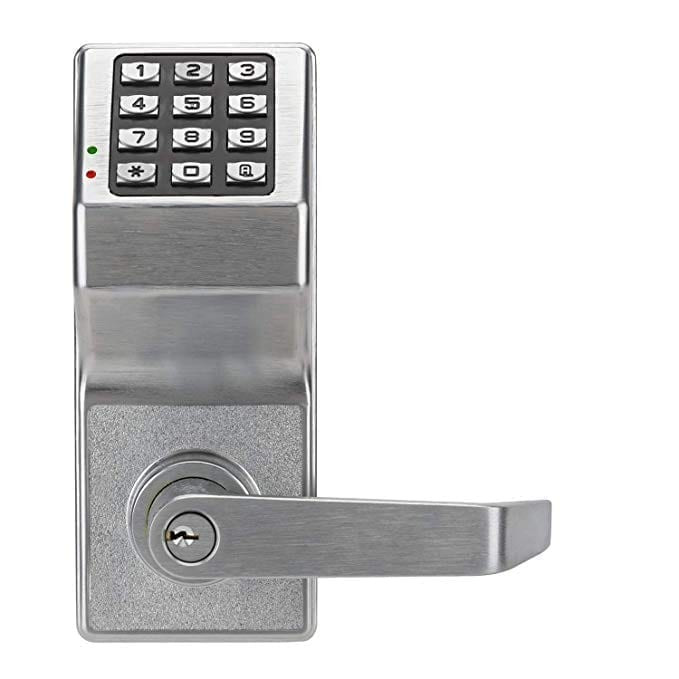
Choose Schlage CO-Series or AD-Series when:
- You're standardizing across a portfolio that already specs Schlage mechanical (ND, L-Series) and want consistent keyways.
- You need a clear upgrade path from standalone (AD-200) to networked (AD-300 hardwired, AD-400 wireless) on the same chassis.
- You want SFIC/LFIC core compatibility for master key integration.
- The opening is a mortise prep and you want a single-source spec from Allegion.
Choose Alarm Lock Trilogy when:
- Budget matters — Trilogy lands at a lower list tier than equivalent Schlage CO or AD.
- You want a clear ladder: Alarm Lock Trilogy T2 DL2700 (basic, no audit) → DL3000 (audit) → Networx ETPDL/ETDL (wireless networked).
- You're retrofitting existing cylindrical prep — the DL2700/DL3000 install on a 161 prep.
- You need narrow-stile aluminum door coverage via Alarm Lock.
Choose Kaba E-Plex / Simplex when:
- You want a mechanical pushbutton with zero battery maintenance (Simplex 1000) on low-traffic auxiliary doors.
- You're spec'ing a hospitality or multi-tenant environment where the Kaba/dormakaba product family is already in place.
- You need straightforward code management without networked overhead — E-Plex 2000 stores user codes locally with no host.
Need keypad locks now? Browse our commercial keypad lock inventory — facility-grade pricing with verified ANSI ratings on every SKU.
What ANSI/BHMA grade should a commercial keypad lock meet?
For primary entry, classroom, and tenant doors, spec ANSI/BHMA A156.2 Grade 1: 800,000 cycles minimum. Grade 2 (400,000 cycles) is acceptable for moderate-traffic interior doors. Grade 3 (200,000 cycles) is light commercial — avoid on any opening with daily public use.
For mortise keypad locks (Schlage AD-200 mortise, Alarm Lock DL3500CR, Kaba E-Plex mortise variants), the operational standard is A156.13: Grade 1 Operational = 1,000,000 cycles minimum; Grade 2 = 500,000.
Fire-rated openings: avoid the shorthand "UL 10C-rated lock" — UL 10C tests the full door assembly; hardware is UL-listed for use in UL 10C-rated assemblies, with assembly ratings up to 3 hours depending on door and frame construction. NFPA 80 (2025 edition) prohibits any modification that defeats positive latching on a fire-rated assembly.
ADA: ADA 2010 §404.2.7 requires lever or push-pad operation that doesn't require tight grasping, pinching, or twisting of the wrist. Keypad locks paired with a lever trim meet this. ADA §404.2.9 caps interior door opening force at 5 lbf — pair the lock with an appropriately adjusted ADA surface-mounted door closer.
How do you integrate keypad locks with electric strikes and access control?
A standalone keypad lock controls one door. Add an electric strike when you need remote release from a reception desk or intercom, or when the keypad is on the secure side and you need to grant access from elsewhere. The strike replaces the frame strike plate; the keypad lock handles credentialed entry locally.
For multi-door deployments, networked platforms (Schlage AD-300/400, Alarm Lock Networx) push credentials and schedules from a head end. Add readers, keypads and credentials compatible with HID prox or iCLASS if you want card-plus-PIN dual authentication on the same opening.
How many user codes and audit-trail events do they support?

Capacity varies widely. Don't trust marketing rounding — verify against the datasheet for the exact SKU you spec. As a rough framework:
- Entry-level standalone (Kaba Simplex 1000 mechanical): one combination, no audit.
- Basic electronic standalone (Alarm Lock DL2700, Schlage CO-100): small user-code database, no audit.
- Mid-tier standalone with audit (Alarm Lock DL3000, Schlage CO-200): larger user database, on-board audit buffer.
- Networked (Schlage AD-300/400, Alarm Lock Networx): large user databases, audit pushed to head end.
At 50 entries/day, a 1,000-event audit buffer fills in 20 days — pull data on a schedule that matches your traffic.
Do keypad door locks need to be hardwired or are they battery powered?
Most standalone keypad locks (Schlage CO-Series, AD-200, Alarm Lock Trilogy DL series, Kaba E-Plex) run on 4 AA batteries. Expected life depends on traffic:
- Low traffic (<20 entries/day): 3-5 years on 4 AA
- Medium traffic (20-100/day): 1-2 years
- High traffic (100+/day): 6-12 months
Networked hardwired platforms (Schlage AD-300) require RS-485 wiring and PoE or low-voltage power. Wireless networked (AD-400, Alarm Lock Networx) still run on batteries at the door — the radio link to the gateway is the only network connection. For multi-door networked deployments, plan access control power supplies sized to total panel and strike load with battery backup.
How do these keypad lock platforms compare side by side?
| Brand/Series | BHMA Grade | Cycle Rating | Best For | List Price Tier |
|---|---|---|---|---|
| Schlage CO-200 | A156.2 Grade 1 | 800,000 minimum per A156.2 | Standalone offline; offices, classrooms, tenant suites with audit | $$$ |
| Schlage AD-200 | A156.13 Grade 1 Operational | 1,000,000 minimum per A156.13 | Standalone mortise with upgrade path to networked AD-300/400 | $$$$ |
| Alarm Lock Trilogy DL2700 | A156.2 Grade 1 | 800,000 minimum per A156.2 | Budget standalone keypad, no audit needed | $$ |
| Alarm Lock Trilogy DL3000 | A156.2 Grade 1 | 800,000 minimum per A156.2 | Standalone with on-board audit trail | $$ |
| Kaba Simplex 1000 (dormakaba) | A156.2 Grade 1 | 800,000 minimum per A156.2 | Mechanical pushbutton; no batteries, low-traffic utility doors | $$ |
| Kaba E-Plex 2000 (dormakaba) | A156.2 Grade 1 | 800,000 minimum per A156.2 | Electronic standalone, multi-user codes, no networking | $$$ |
Pair your keypad lock with the right closer, hinges, and — if remote release matters — an electric strike on the frame side. Shop commercial electronic keypad locks at ZenSupply for in-stock Schlage, Alarm Lock, and Kaba inventory with verified ANSI grades and same-week shipping on standard finishes.