


Commercial Panel Board Sizing Guide: How to Calculate Load Requirements
Posted by ZenSupply Electrical Team on Jun 11th 2026

TL;DR — Quick Pick
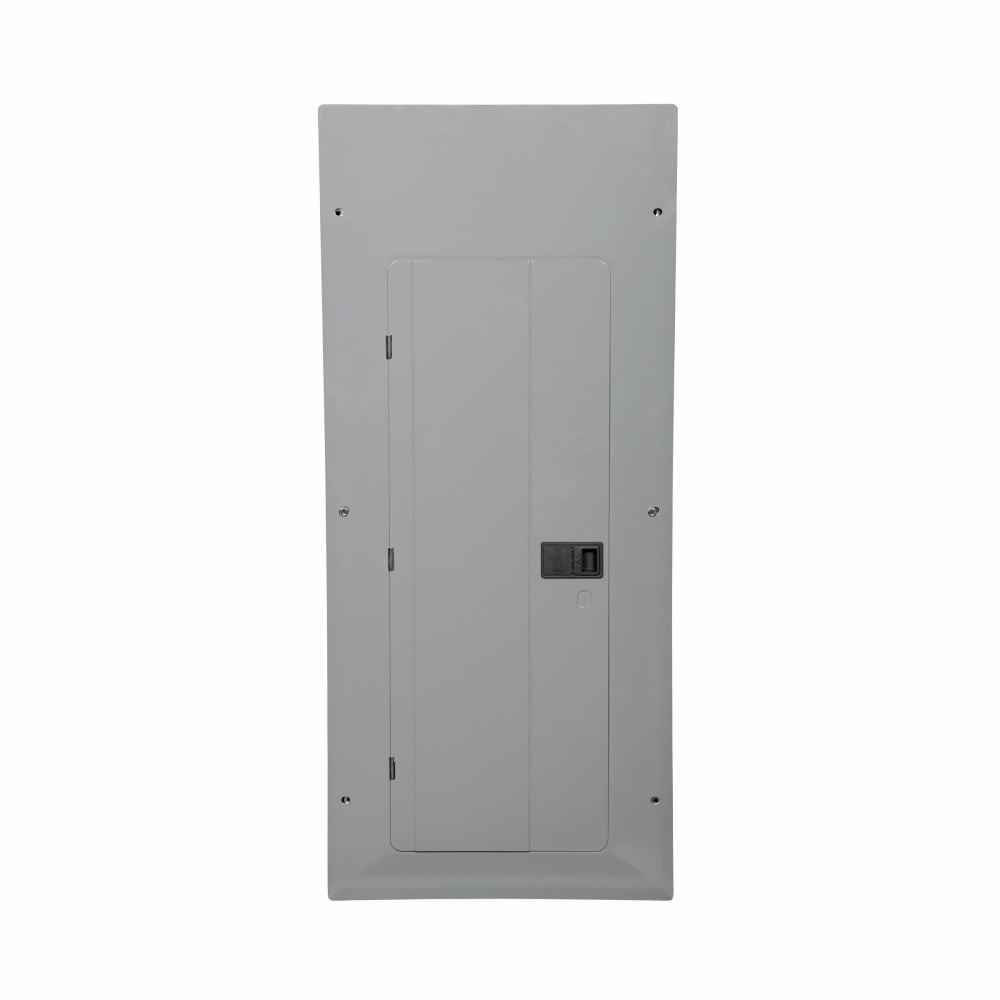
- Eaton Power Series — UL 67 listed, 225A-1200A busbar ratings, ideal for institutional and industrial facilities requiring robust short-circuit ratings and modular expansion
- Square D NF Panelboards — 100A-1200A configurations, NEMA Type 1/3R options, spec-grade choice for commercial buildings with high branch circuit density
- Siemens P1 Series — compact footprint, 100A-400A ratings, best for tenant improvement and light commercial applications where space is limited
- NEC Article 220 compliance — apply 125% continuous load factor, use demand factors per Table 220.42 for commercial occupancies, verify busbar ampacity meets calculated load
- Main breaker vs main lug — main breaker panels provide integral overcurrent protection at service entrance; main lug panels require upstream protection, used as sub-panels fed from larger distribution equipment
What is a commercial panel board and how does it differ from residential?

A commercial panel board is a UL 67-listed distribution assembly designed to divide electrical power from a feeder circuit into multiple branch circuits, each protected by circuit breakers or fuses. Unlike residential load centers (UL 50 listed), commercial panel boards handle higher fault currents, accommodate more circuits, and meet stricter NEC requirements for commercial occupancies.
Commercial panels use bolt-on breakers rather than plug-on types, feature higher short-circuit current ratings (SCCR) — typically 22kA to 65kA — and include provisions for ground fault protection per NEC 230.95. The busbar is rated for continuous duty at full ampacity without derating, unlike residential panels which often require 80% derating for continuous loads.
Key differences: commercial panels comply with NEC Article 408 (switchboards and panelboards), require dedicated equipment grounding conductors per 250.122, and must meet stricter labeling and arc flash warning requirements under NFPA 70E. Commercial panel boards and load centers are engineered for 20+ year service life in demanding environments — offices, retail, healthcare, industrial facilities.
Residential load centers use thermal-magnetic breakers rated for 10kA interrupting capacity, adequate for typical utility service. Commercial panels accommodate molded case circuit breakers (MCCBs) with adjustable trip settings, electronic trip units, and ground fault protection — critical for motor loads, HVAC equipment, and sensitive electronics.
How do you calculate total connected load for panel board sizing?

Start with a complete circuit schedule listing every load: lighting (VA), receptacles (VA), HVAC (nameplate amps), motors (nameplate FLA), and any special equipment. NEC Article 220 provides calculation methods for different occupancy types.
For general lighting and receptacles in commercial buildings, apply NEC Table 220.12 unit loads: 1 VA per square foot for offices, 2 VA per square foot for retail, 3.5 VA per square foot for schools. Multiply by total floor area served by the panel. Add receptacle loads at 180 VA per outlet (NEC 220.14(I)), unless actual connected load is known and documented.
Motor loads require special treatment per NEC 430.24: use 125% of the largest motor's full-load current plus 100% of all other motor loads. For HVAC equipment, use the nameplate rating or NEC Table 430.250 values, whichever is greater. Continuous loads (operating 3+ hours) must be calculated at 125% per NEC 210.19(A)(1) and 215.2(A)(1).
Apply demand factors from NEC Table 220.42 for commercial occupancies: first 3000 VA at 100%, next 117,000 VA at 35%, remainder at 25%. This accounts for diversity — not all loads operate simultaneously. For restaurants, hospitals, and industrial facilities, use occupancy-specific demand factors from NEC 220.56 and 220.60.
Sum the adjusted loads to determine total calculated load in amperes. Divide total VA by system voltage (208V, 240V, 480V) and power factor (typically 0.9 for mixed loads). This is your minimum panel busbar rating. Round up to the next standard panel size: 100A, 225A, 400A, 600A, 800A, 1000A, 1200A.
Example: 10,000 sq ft office building, 120/208V three-phase service. Lighting: 10,000 × 1 VA = 10,000 VA. Receptacles: 50 outlets × 180 VA = 9,000 VA. HVAC: 30A × 208V × 1.732 = 10,800 VA. Total connected: 29,800 VA. Apply demand: first 3000 at 100% = 3000, next 26,800 at 35% = 9,380. Total demand: 12,380 VA. Amperes: 12,380 ÷ (208 × 1.732) = 34.4A. Add 125% for continuous HVAC: 34.4 + (10,800 ÷ 360 × 0.25) = 42A. Minimum panel: 100A.
What are NEC requirements for panel board sizing and load calculations?
NEC Article 408 governs panel board construction and installation. Section 408.36 requires overcurrent protection for panel busbars not exceeding the busbar ampacity rating. Main breaker or main lugs must match or protect the busbar — a 400A panel requires 400A maximum overcurrent device.
NEC 110.14(C) addresses termination temperature limits. Conductors must be sized for the lower of: conductor ampacity at 75°C or 90°C (per Table 310.16), or termination rating (typically 75°C for circuits 100A and below, 75°C or 90°C for circuits over 100A). Most commercial panels use 75°C-rated terminals. Verify manufacturer specifications.
Continuous loads require 125% sizing per NEC 210.19(A)(1), 210.20(A), 215.2(A)(1), and 215.3. If a load operates 3+ hours continuously — lighting, HVAC, refrigeration — the circuit breaker and conductor must be rated at 125% of the load. A 20A continuous load requires a 25A breaker minimum, or a 30A breaker with conductor sized for 25A.
NEC 408.54 limits the number of overcurrent devices (poles) in a lighting and appliance branch circuit panel to 42. Commercial power panels have no such limit. If your panel serves primarily lighting and receptacles, verify pole count. Tandem breakers count as two poles.
Ground fault protection is mandatory per NEC 230.95 for solidly grounded wye services over 150V to ground and 1000A or more. This applies to 480Y/277V and 208Y/120V services at 1000A+. The panel or upstream switchgear must include ground fault sensing and tripping, set at 1200A maximum.
NEC 110.16 requires arc flash warning labels on all electrical equipment likely to require examination, adjustment, servicing, or maintenance while energized. Your panel must display an arc flash label indicating incident energy, arc flash boundary, and required PPE level per NFPA 70E. Coordinate with a qualified engineer for arc flash study.
Voltage drop is not a code requirement but a design consideration. NEC 210.19(A) Informational Note recommends limiting voltage drop to 3% on branch circuits and 5% total (feeder + branch). For a 400A feeder at 208V over 150 feet, use NEC Chapter 9 Table 9 to calculate conductor size ensuring voltage drop stays under 3%.
How do you determine the correct busbar rating for a panel board?

Busbar rating is the maximum continuous current the panel's copper or aluminum bus can safely carry without exceeding temperature limits. Standard ratings: 100A, 125A, 150A, 200A, 225A, 400A, 600A, 800A, 1000A, 1200A. Select a busbar rating equal to or greater than your calculated demand load.
The busbar must also meet short-circuit current rating (SCCR) requirements. SCCR is the maximum fault current the panel can withstand without catastrophic failure. Determine available fault current at the panel location using utility transformer data and upstream impedance. Typical commercial panels offer 22kA, 42kA, or 65kA SCCR. Match or exceed the available fault current.
For main lug panels fed from upstream switchgear, the busbar rating must not exceed the feeder overcurrent device rating. If a 400A breaker feeds the panel, use a 400A busbar maximum. Oversizing the busbar (e.g., 600A busbar with 400A feeder) is permissible but offers no benefit and increases cost.
Busbar material affects ampacity and cost. Copper busbars have lower resistance and better conductivity than aluminum, allowing smaller physical size for the same ampacity. Aluminum is lighter and less expensive but requires larger cross-sectional area. Verify termination compatibility — aluminum busbars require anti-oxidant compound and torque per manufacturer specs.
Future expansion considerations: if load growth is anticipated, specify a busbar rated 25-50% above current calculated load. A 300A calculated load might justify a 400A busbar, allowing circuit additions without panel replacement. Balance upfront cost against future flexibility.
Ambient temperature derating applies per NEC 310.15(B)(2) if the panel is installed in a high-temperature environment (above 30°C/86°F). Rooftop mechanical rooms, boiler rooms, and outdoor NEMA 3R enclosures may require derating. Consult NEC Table 310.15(B)(2)(a) for correction factors. A 400A busbar in a 50°C environment requires 0.82 correction factor, effectively reducing capacity to 328A.
What is the difference between main breaker and main lug panels?
Main breaker panels include an integral circuit breaker at the top or bottom of the panel that protects the entire busbar and all downstream branch circuits. The main breaker serves as the service disconnect per NEC 230.70, allowing a single motion to de-energize the panel. Main breaker panels are used at service entrance locations where utility power enters the building.
Main lug panels have no main breaker — only lugs (compression terminals) where feeder conductors connect to the busbar. Overcurrent protection is provided by an upstream breaker in a switchboard, switchgear, or another panel. Main lug panels are used as sub-panels or distribution panels fed from a larger main distribution panel.
NEC 408.36 requires overcurrent protection for the panel busbar. In a main breaker panel, the main breaker provides this protection. In a main lug panel, the upstream feeder breaker provides protection. The feeder breaker rating must not exceed the panel busbar rating.
Cost difference: main breaker panels cost 15-30% more than equivalent main lug panels due to the integrated breaker. For a 400A panel, expect $800-1200 premium for main breaker configuration. Main lug panels are more economical when the service disconnect is located upstream in a separate enclosure.
Application: use main breaker panels at service entrance, meter-main combinations, and locations requiring a local disconnect per NEC 230.70. Use main lug panels for sub-distribution, tenant panels fed from building main switchgear, and remote panels where the feeder originates from a main breaker panel.
Six-disconnect rule (NEC 230.71): if multiple main breaker panels are grouped at a service entrance, no more than six hand motions are permitted to disconnect all service conductors. This limits service entrance configurations to six main breaker panels maximum. Main lug panels do not count toward the six-disconnect limit if fed from a single main service disconnect.
How do continuous loads affect panel board sizing calculations?
NEC defines a continuous load as any load where the maximum current is expected to continue for three hours or more. Lighting, HVAC, refrigeration, and most commercial equipment qualify as continuous. Receptacles are generally considered non-continuous unless serving dedicated equipment.
NEC 210.19(A)(1) and 215.2(A)(1) require conductors and overcurrent devices for continuous loads to be sized at 125% of the continuous load. This prevents thermal stress on breakers and conductors operating at full capacity for extended periods. A 30A continuous load requires a 37.5A minimum breaker — round up to 40A standard size.
For panel busbar sizing, sum all continuous loads at 125% plus non-continuous loads at 100%. Example: 80A continuous lighting + 40A non-continuous receptacles = (80 × 1.25) + 40 = 140A minimum busbar. Select a 150A or 200A panel.
Breaker selection: molded case circuit breakers are rated for 80% continuous duty unless marked "100% rated." A standard 100A breaker can carry 80A continuously. A 100% rated breaker can carry 100A continuously. Verify breaker markings and manufacturer data.
Temperature rise is the concern. Continuous loads generate heat in busbars, breakers, and conductors. The 125% factor provides thermal margin, keeping equipment below rated temperature limits. Inadequate sizing leads to nuisance tripping, premature breaker failure, and potential fire hazards.
Mixed loads require careful calculation. If a panel serves 60A continuous HVAC, 40A continuous lighting, and 30A non-continuous receptacles, calculate: (60 + 40) × 1.25 + 30 = 155A. Minimum panel: 200A. Each continuous circuit also requires individual 125% sizing — a 20A continuous lighting circuit needs a 25A breaker (round to 30A) or a 20A breaker rated 100% continuous.
What safety factors and derating considerations apply to panel boards?
Ambient temperature derating per NEC 310.15(B)(2) applies when panels are installed in environments exceeding 30°C (86°F). Rooftop equipment rooms, mechanical spaces, and outdoor NEMA 3R enclosures often exceed this threshold. Use Table 310.15(B)(2)(a) correction factors. At 40°C, apply 0.91 factor; at 50°C, apply 0.82 factor.
Conductor bundling derating per NEC 310.15(B)(3)(a) applies when more than three current-carrying conductors occupy a raceway or cable. For 4-6 conductors, apply 80% factor; 7-9 conductors, 70%; 10-20 conductors, 50%. This affects feeder sizing to the panel. A 400A feeder with six conductors in a single conduit requires 400A ÷ 0.80 = 500A conductor ampacity before temperature correction.
Harmonic currents from electronic loads (computers, LED lighting, variable frequency drives) require neutral conductor sizing per NEC 310.15(B)(5)(c). Harmonics do not cancel in the neutral — they add. For circuits serving nonlinear loads, size the neutral conductor for 100% of the unbalanced load, not reduced per 220.61. Some engineers specify double-sized neutrals (e.g., #2 AWG neutral with #1/0 AWG phase conductors).
Short-circuit current rating (SCCR) must meet or exceed available fault current at the panel location. Calculate fault current using utility transformer impedance, conductor impedance, and upstream protective device let-through current. A 1500 kVA transformer at 480V with 5.75% impedance can deliver 30kA+ fault current. Specify a panel with 42kA or 65kA SCCR.
Arc flash incident energy determines required PPE and safe working distances per NFPA 70E. Panels above 240V or with available fault current over 25kA require arc flash labels indicating incident energy (cal/cm²), arc flash boundary, and PPE category. Coordinate with a qualified electrical engineer for arc flash hazard analysis. Typical commercial panels range from 1.2 cal/cm² (PPE Category 1) to 8+ cal/cm² (PPE Category 2 or 3).
Voltage drop limits are not code requirements but design best practices. NEC 210.19(A) Informational Note recommends 3% maximum on branch circuits, 5% total (feeder + branch). For a 400A feeder at 208V over 200 feet, calculate voltage drop using conductor resistance from NEC Chapter 9 Table 8. Use parallel conductors or larger wire size to stay under 3%.
Seismic bracing per IBC 2024 Section 1613 and ASCE 7 applies in seismic zones. Panels over 400A or weighing over 400 lbs require seismic restraints — typically lateral bracing to building structure. Verify local amendments. California, Oregon, Washington, and Alaska have strict seismic requirements.
How do you select the right number of circuits and panel configuration?
Circuit count depends on load diversity and NEC requirements. Start with a complete load schedule: lighting circuits, receptacle circuits, HVAC equipment, motors, and special loads. NEC 210.11(B) requires at least two 20A small appliance circuits in commercial break rooms, plus separate circuits for HVAC, elevators, and fire alarm systems.
Lighting circuits: NEC 220.12 and 210.23(A) limit lighting loads to 80% of circuit rating for continuous loads. A 20A circuit can serve 16A continuous lighting — roughly 1920 VA at 120V. For a 10,000 sq ft office at 1 VA/sq ft, you need 10,000 VA ÷ 1920 VA = 5.2 circuits, round to 6 circuits minimum.
Receptacle circuits: NEC 210.11(C)(1) requires one 20A receptacle circuit per 180 VA of calculated load. For offices, assume 1 VA/sq ft receptacle load (in addition to lighting). A 10,000 sq ft office needs 10,000 VA ÷ (20A × 120V × 0.8) = 5.2 circuits, round to 6 circuits. Alternatively, use one circuit per 10 receptacles as a rule of thumb.
HVAC and motor loads require dedicated circuits per NEC 430.22 and 440.32. Each HVAC unit, exhaust fan, and motor-driven equipment needs a separate circuit sized at 125% of nameplate rating. A 15A HVAC unit requires a 20A circuit minimum.
Panel configuration: specify the number of spaces (circuit positions) based on current load plus 20-25% spare capacity for future expansion. A panel serving 30 circuits should have 36-40 spaces. Standard configurations: 12, 18, 20, 24, 30, 36, 42 spaces for lighting and appliance panels; 12, 18, 24, 30, 36, 42 spaces for power panels.
Three-phase vs single-phase: commercial buildings typically use 208Y/120V or 480Y/277V three-phase service. Lighting and receptacles connect line-to-neutral (120V or 277V single-phase). HVAC and motors connect line-to-line (208V or 480V three-phase). Specify a three-phase panel with balanced loading across all three phases. Aim for ±10% balance to minimize neutral current.
Breaker types: use miniature circuit breakers (MCBs) for lighting and receptacle circuits up to 63A. Use molded case circuit breakers (MCCBs) for feeders and large equipment circuits 70A-1200A. Specify AFCI breakers for commercial sleeping areas (hotels, dormitories) per NEC 210.12(C). Specify GFCI breakers for wet locations, rooftops, and outdoor receptacles per NEC 210.8(B).
Panel schedule documentation: create a typed panel schedule listing every circuit, load description, breaker size, and conductor size. Mount the schedule inside the panel door per NEC 408.4. Update the schedule whenever circuits are added or modified. This is critical for maintenance, troubleshooting, and future renovations.
Need commercial panel boards now? Browse our panel board inventory — UL-listed Eaton, Square D, and Siemens panels in stock with same-day shipping for electricians and contractors.
How Eaton compares to Square D and Siemens for commercial panel boards
Eaton Power Series panels dominate institutional and industrial specifications due to robust construction, high SCCR ratings (up to 65kA), and modular design allowing field-installed accessories. Busbar ratings span 225A-1200A. Eaton's bolt-on breaker design ensures secure connections under vibration and thermal cycling. The Power Series accommodates Eaton's complete line of molded case breakers, including electronic trip units with ground fault and arc flash protection.
Square D NF Panelboards hold significant market share in commercial construction — offices, retail, healthcare. Available in 100A-1200A configurations with NEMA Type 1 (indoor) and Type 3R (outdoor) enclosures. Square D's QO and QOB breaker lines offer plug-on convenience for smaller panels, while I-Line bolt-on breakers serve larger installations. Square D panels integrate with PowerLogic metering for energy monitoring and power quality analysis.
Siemens P1 Series panels target light commercial and tenant improvement projects where compact footprint and cost efficiency matter. Busbar ratings 100A-400A. Siemens uses a hybrid plug-on/bolt-on breaker system — plug-on for quick installation, bolt-on for high-current circuits. The P1 Series offers good SCCR (22kA standard, 42kA optional) and accepts Siemens' full breaker line including AFCI, GFCI, and combination types.
Eaton excels in heavy industrial, manufacturing, and mission-critical facilities requiring maximum fault current protection and long-term reliability. Square D dominates commercial office and retail where contractor familiarity, availability, and integration with building management systems drive specifications. Siemens competes on price and compact design for smaller commercial projects and tenant spaces.
All three brands meet UL 67 standards and NEC requirements. Differences lie in breaker availability, accessory options, and regional distributor support. Eaton and Square D maintain broader distribution networks. Siemens offers competitive pricing but fewer stocking distributors in some regions.
Choose Eaton Power Series when:
- Available fault current exceeds 42kA — Eaton offers 65kA SCCR standard on many configurations
- Project requires modular expansion — Eaton's split-bus and section-feed designs allow phased installation
- Specification calls for electronic trip breakers with advanced protection — Eaton's Magnum DS and Pow-R-Command breakers offer programmable settings, ground fault, and arc flash reduction
- Industrial or institutional environment demands robust construction — Eaton's heavy-gauge steel enclosures and reinforced busbar supports withstand vibration and mechanical stress
Choose Square D NF Panelboards when:
- Project requires integration with Schneider Electric building management systems — Square D panels interface with PowerLogic, EcoStruxure, and StruxureWare platforms
- Contractor familiarity and local availability are priorities — Square D maintains the largest distributor network and contractor training programs
- Specification includes energy monitoring and power quality analysis — Square D's metering options and communication modules are industry-standard
- NEMA 3R outdoor enclosures are required — Square D offers factory-assembled outdoor panels with integral rain shields and corrosion-resistant hardware
Choose Siemens P1 Series when:
- Budget constraints favor lower first cost — Siemens panels typically price 10-15% below Eaton and Square D equivalents
- Space limitations require compact panel dimensions — Siemens P1 Series offers smallest footprint in 100A-400A range
- Tenant improvement or light commercial application doesn't justify heavy-duty construction — Siemens provides adequate performance at lower cost
- Project timeline benefits from plug-on breaker installation speed — Siemens hybrid system allows faster circuit additions during construction
| Brand/Series | Busbar Range | SCCR Standard | Best For | List Price Tier |
|---|---|---|---|---|
| Eaton Power Series | 225A-1200A | 42kA-65kA | Industrial, institutional, high fault current applications | $$$ (premium) |
| Square D NF Panelboards | 100A-1200A | 22kA-42kA | Commercial office, retail, healthcare, BMS integration | $$$ (premium) |
| Siemens P1 Series | 100A-400A | 22kA-42kA | Light commercial, tenant improvement, cost-sensitive projects | $$ (mid-range) |
| GE PowerMark Gold | 100A-400A | 22kA | Small commercial, residential multi-family, basic applications | $ (economy) |
Need help sizing a panel board for your project? Contact ZenSupply — our electrical specialists provide load calculations, NEC compliance verification, and same-day quotes on Eaton, Square D, and Siemens panels. We stock molded case circuit breakers, safety switches, and wire termination lugs for complete panel installations.