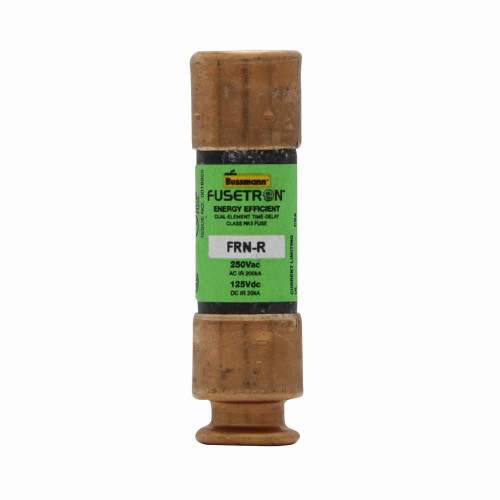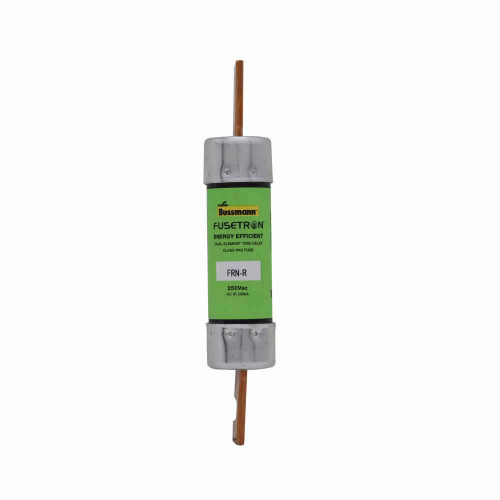
Bussmann FRS-R Series Class RK...
IN STOCK (leaves warehouse same day if ordered before 3pm ET)
$341.38

Bussmann FRS-R Series Class RK5 Dual-Element Time-Delay Fuse

(No reviews yet) Write a Review

Model: FRS-R-600

In Stock (leaves warehouse same day if ordered before 3pm ET)

$341.38
Adding to cart… The item has been added
Free Shipping on orders over $199
We price match and offer bulk discounts! Click Add to Quote. It's quick and easy.
✨
Earn points with this purchase! You can redeem points for giftcards, iPads, XBox's and more. View Rewards
Free Keying on all locks

Bussmann FRS-R Series Class RK5 Dual-Element Time-Delay Fuse

The Bussmann FRS-R Series Class RK5 dual-element time-delay fuse delivers professional-grade overcurrent protection for motor circuits, transformers, and other inductive loads, and is available in amp ratings from 1A up to 225A to match a wide range of circuit protection needs. Dual element construction combines time-delay response for motor starting and transformer inrush currents with fast-acting protection against short circuits, achieving a 10-second response time at 500% of rated current. Rated 600VAC/250VDC with Class RK5 current limiting, the FRS-R Series is built for electrical contractors, industrial facilities, and commercial installations that demand reliable, code-compliant circuit protection.

Key Features

  • Amp Rating Range: Offered across the FRS-R Series from 1A to 225A, so the correct fuse can be selected for the specific motor, transformer, or lighting circuit being protected.
  • Dual Element Construction: Combines time-delay characteristics for motor starting currents with fast response to short circuits.
  • 10-Second Response at 500%: Allows temporary overloads such as motor starting or transformer energizing while still protecting against sustained overcurrent conditions.
  • Class RK5 Current Limiting: Reduces let-through energy and limits fault current to protect downstream equipment and reduce arc flash hazards.
  • Voltage Rating: 600VAC/250VDC for use across a broad range of AC and DC circuit applications.
  • High Interrupt Rating: 200 kAIC at 600VAC and 20 kAIC at 250VDC for superior fault-clearing capability.
  • Ferrule End Connection: Non-indicating, professional ferrule-end construction for secure seating in fuse clips and reliable electrical connections.

Certifications & Compliance

  • CE Marked Compliance for international electrical safety standards.

Technical Specifications

  • Product Type: Time Delay Fuses

Typical Applications

  • Motor Protection Circuits
  • Transformer Primary Protection
  • Industrial Control Panels
  • Commercial Lighting Circuits (Ballast Inrush Protection)
  • HVAC Equipment Protection
  • Power Distribution Systems

Why Bussmann?

Bussmann backs the FRS-R Series with dual-element time-delay construction, Class RK5 current limiting, and CE marked compliance, giving electrical contractors and facility managers the fault-clearing capability and selective coordination performance they rely on for motor protection, transformer circuits, and industrial electrical installations that demand consistent, reliable overcurrent protection.

Manufacturer Resources

Product Specs

Class:
Class RK5
Number Of Elements:
Dual
Packaging Type:
Standard
Department:
Electrical
Product Type:
Time Delay Fuses
Series:
FRS-R
Voltage Rating:
600VAC/250VDC
Amperage Rating:
1A - 225A
Connection Type:
Ferrule End
Listing:
CE Marked
Product Group:
Fuses
Product Subgroup:
Time Delay Fuses

Bussmann FRS-R-600 – Frequently Asked Questions

1) Will a Bussmann FRS-R fuse hold in when my motor starts, or will it blow on inrush?
The FRS-R is a dual-element time-delay fuse built exactly for that. It carries a 10 second response at 500% of rated current, so a motor pulling five times full-load amps during acceleration rides through instead of clearing the fuse. The second element still reacts fast to a genuine short circuit. That combination is why it is used on motor circuits, transformer primaries, and ballast inrush on lighting.
2) Will an FRS-R fuse fit my existing Class R fuse block or disconnect?
The FRS-R is a Class RK5 fuse with ferrule ends, so it seats in standard Class R clips. Ferrule construction runs on the lower amp ratings; the larger ratings in the series go up to 600A. If your holder has the Class R rejection feature, an RK5 fuse drops in. A holder built only for non-rejection Class H or K fuses will accept it, but a Class R rejection clip will not accept a Class H fuse in return.
3) What is the difference between an RK5 fuse like the FRS-R and an RK1 fuse?
Both are Class R and both fit the same Class R clips, so they are physically interchangeable. The difference is let-through energy: RK1 is the more current-limiting of the two, RK5 lets through more under a bolted fault. The FRS-R is RK5 and current limiting, which reduces let-through energy and fault current to downstream equipment. If an equipment nameplate or a coordination study calls out RK1 specifically, do not substitute RK5 for it. For general motor and transformer protection where the label just says Class R time delay, RK5 is the usual choice.
4) How do I size an FRS-R fuse for a motor, same amps as the motor?
No, and this is where people get it wrong. A dual-element time-delay fuse on a motor branch circuit is sized above the motor full-load amps, typically around 125% for running protection, not at the nameplate amps. Size at the FLA and it will nuisance-open on the next start. The FRS-R holds 500% of its rating for 10 seconds, which is what lets a modestly oversized fuse still protect against a sustained overload. Ratings run in close steps through the common motor range (30, 35, 40, 45, 50, 60, 70), so you can land on the right number.
5) Can an FRS-R fuse replace a Fusetron FRN-R in my 240V panel?
Not directly on voltage grounds, and the swap only goes one way. FRS-R is the 600V member of the Fusetron dual-element family and FRN-R is the 250V member; both are Class RK5 with the same time-delay characteristic. Putting a 600V-rated FRS-R where a 250V fuse was is acceptable, since a fuse may be applied at or below its voltage rating. Going the other direction, an FRN-R on a 480V circuit, is not. Note the fuse bodies differ in length between the two voltage classes, so confirm the holder takes the 600V case before ordering.
6) What amp ratings does the Bussmann FRS-R come in?
The series runs 1A through 600A. Below 10A there are fractional and odd steps a control circuit needs: 1, 2, 2.8, 3, 5, 6, 6.25, 8, 9 and 10 amps. From there it steps 12, 15, 20, 25, 30, 35, 40, 45, 50, 60, 70, 75, 80, 90, 100, 125, 150, 175, 200, 225, 250, 300, 350, 400, 450, 500 and 600. Order by the ampere number in the part code, for example FRS-R-30 for a 30 amp.
7) Can I use the same FRS-R fuse on a transformer primary as on a motor?
Yes, and that is one of its main uses. Transformer energizing inrush is a short, high magnitude pulse much like motor starting, and the time-delay element rides it out while still clearing a sustained fault. The series is used on transformer primaries, control panels, HVAC equipment, lighting circuits with ballast inrush, and power distribution. Size the fuse to the transformer primary requirement for your installation, not to the motor rule.
8) What part number do I order for a 100 amp FRS-R, and how are the fractional ratings written?
Whole-amp ratings append the number: FRS-R-100 for 100 amps, FRS-R-15 for 15 amps. The fractional ratings keep the fraction in the code rather than a decimal, so 2.8 amps is FRS-R-2-8/10 and 6.25 amps is FRS-R-6-1/4. Getting that formatting right matters when you are matching a fuse already in a control panel.
9) Will a Class RK5 fuse help with arc flash and selective coordination on my distribution gear?
Class RK5 current limiting on the FRS-R reduces let-through energy and limits fault current reaching downstream equipment, which lowers arc flash hazard at that point. Bussmann positions the series for selective coordination on motor and transformer circuits. Actual coordination between upstream and downstream devices depends on the specific ratings in your system and is settled by your coordination study, not by the fuse class alone.
10) Is the FRS-R a rejection style fuse, and does it have a blown fuse indicator?
Class RK5 with ferrule ends, and non-indicating. There is no window or pop-up pin, so you test with a meter rather than reading it by eye. If your panel crew relies on visual indication for fast troubleshooting, spec an indicating fuse or add an external blown-fuse indicator on the holder.
11) Are Bussmann FRS-R fuses CE marked?
Yes, the FRS-R Series carries CE marking for international electrical safety compliance.
How fast can I get the Bussmann FRS-R-600 delivered?
Most orders ship the same day from our distribution partners, with quick delivery throughout the continental U.S. Need it urgently? Contact Us for expedited shipping options.
Can I return it if it doesn’t work for me?
Yes—ZenSupply offers a hassle-free return policy. If the product isn’t the right fit, reach out to our support team for a return authorization or setup a return by following our return instructions.
Does the Bussmann FRS-R-600 come with a warranty?
Absolutely. The Bussmann FRS-R-600 is backed by a manufacturer’s warranty. For full warranty terms, check the product documentation or Contact Us.
How do I get technical support or installation help for the Bussmann FRS-R-600?
You can call, text, or email our expert support team for fast answers. We’re here to help with product selection, installation tips, and troubleshooting. Contact Us
Why buy the Bussmann FRS-R-600 from ZenSupply?
ZenSupply makes it easy to get the commercial door hardware you need—fast shipping, expert support, and rewards on every order. Our team is always ready to help you choose the right product for your project.