


You may also like

Ives 60A Aluminum Baseboard Door Stop with 3-3/4" Projection and 1" Base
Model: IVE-60A
Ives 60A Aluminum Baseboard Door Stop with 3-3/4" Projection and 1" BaseProfessional Baseboard Door Stop SolutionThe Ives 60A aluminum baseboard door stop provides reliable door protection with a...
Ives
Starting at
$5.60
$2.70

Ives 61B Brass Baseboard Door Stop with 3-1/8" Projection and 7/8" Base
Model: IVE-61B
Ives 61B Brass Baseboard Door Stop with 3-1/8" Projection and 7/8" BaseProfessional Baseboard Door Stop SolutionThe Ives 61B brass baseboard door stop provides reliable door protection with a 3-1/8"...
Ives
Starting at
$19.90
$9.61

Ives 60B Brass Baseboard Door Stop with 3-3/4" Projection and 1" Base Diameter
Model: IVE-60B
Ives 60B Brass Baseboard Door Stop with 3-3/4" Projection and 1" Base DiameterProfessional Baseboard Door Stop SolutionThe Ives 60B brass baseboard door stop provides reliable door protection with a...
Ives
Starting at
$27.80
$25.48

Ives 64 Brass Baseboard Door Stop with 3-1/4" Projection
Model: IVE-64
Ives 64 Brass Baseboard Door Stop with 3-1/4" ProjectionProfessional Baseboard Door Stop SolutionThe Ives 64 Brass Baseboard Door Stop delivers reliable door protection with deluxe one-piece styling...
Ives
Starting at
$24.30
$11.41

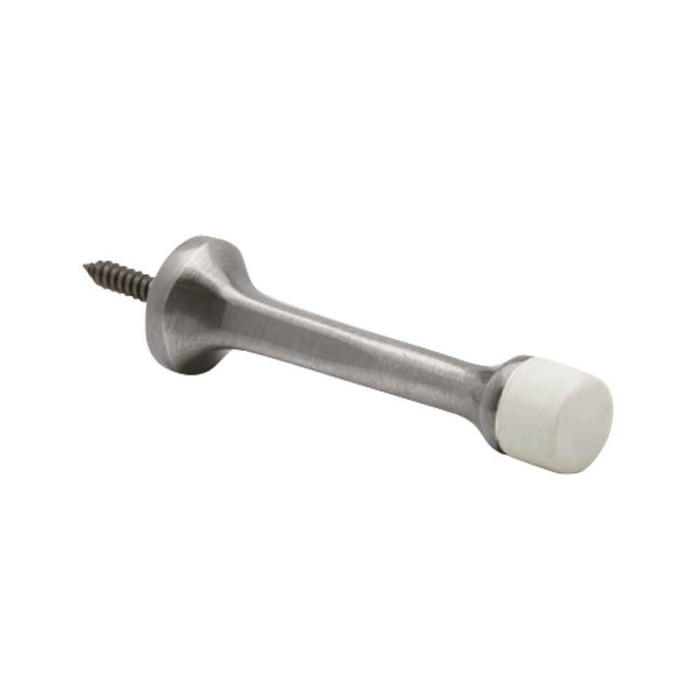
Ives 61A Aluminum Baseboard Door Stop
The Ives 61A is a rigid aluminum baseboard door stop with a 3-3/16" projection and 7/8" base diameter. It mounts to wood baseboards using a welded fastener and ships disassembled for installation with a standard screwdriver. A non-marring rubber tip protects wall and door surfaces on contact. Meets ANSI/BHMA 156.16 for door stops and holders.
Features
- 3-3/16" projection accommodates standard door trim clearances
- 7/8" base diameter for low-profile, stable mounting
- Aluminum construction with welded fastener for wood baseboard applications
- Non-marring rubber tip protects wall finishes and door surfaces
- Ships disassembled; installs with a screwdriver only
- ANSI/BHMA 156.16 compliant
- Available in multiple finishes to match existing door hardware
Typical Applications
- Residential interior doors: bedrooms, bathrooms, closets, utility rooms
- Apartment and condominium units
- Multi-family residential properties
Manufacturer Resources
 Ives Full Line Catalog
Product Specs
- Product Group:
- Door Trim and Accessories
- Subcategory:
- Stops
- Product Subgroup:
- Door Stops, Holders, Silencers & Bumpers
- Product Type:
- Door Stops - Baseboard
- Commercial/Residential:
- Residential
- Product Model:
- 61
- Product Dimension:
- 7/8" Base Diameter
- Product Projection:
- 3-3/16"
- Product Category:
- Door Trim and Accessories
- Product Substrate:
- Aluminum
- Department:
- Door Hardware
Ives 61A15 – Frequently Asked Questions
1) Will an Ives 61A baseboard door stop keep the lever from punching a hole in my drywall?
The 61A stops the door 3-3/16 inches out from where it is mounted, which is what keeps the lever or the door edge off the wall. That number is fixed, so measure the actual travel you need before you commit: sight down the door in the open position and check how far the knob or lever sits from the wall face. If the lever still lands short of the stop's contact point, you want a longer projection or a stop mounted somewhere other than the baseboard. The contact end carries a white rubber tip, so where it does meet the door there is no metal-on-finish contact and no marring of the door face.
2) Is the Ives 61A adjustable, or is the projection fixed at 3-3/16 inches?
Fixed. The 61A is a rigid stop at 3-3/16 inches of projection, with no adjustment at the post. If your baseboard and casing are deep enough that 3-3/16 inches does not get the door clear, a couple of other stops we carry go longer: the Delaney solid brass baseboard door stop adjusts from 3-1/2 to 4-1/2 inches, and the Emtek 2231 baseboard door stop is a fixed 4 inches. Hager's 212 is an adjustable rigid stop with an 80 to 120 degree range if what you are really trying to control is how far the door swings rather than how far it sits off the wall.
3) Is the Ives 61A door stop heavy enough for a commercial corridor or a school?
No. Ives grades the 61A as residential, and the build reflects that: an aluminum body on a 7/8 inch diameter base with a welded fastener meant for wood. It is the right part for apartment interiors, closets, bedrooms, and unit turns in multi-family, where a door gets swung a few times a day. For a corridor door, a classroom, or anything getting kicked open all day, step up to a heavy-duty stop such as the Orca Hardware TH-30HD, which is a heavy-duty rigid unit listed with a door holder function.
4) Will the Ives 61A hold a door open?
No. The 61A stops the door and protects the wall with a non-marring rubber tip, but it does not latch or retain the door in the open position. For an opening that has to stay propped, the Orca Hardware TH-30HD is catalogued as a door holder rather than a stop, so it is the substitution to make when the requirement is holding and not just stopping. This is the most common mis-order in this group, because a holder and a rigid stop look alike on the floor.
5) What baseboard door stop projects further than 3-3/16 inches?
The Ives 61A projects 3-3/16 inches from the baseboard, which is what most standard trim depths need. Where the door hits a thicker base, a deeper casing, or a chair rail and needs more reach, the Emtek 2231 baseboard door stop projects 4 inches, and the Delaney solid brass baseboard door stop adjusts from 3-1/2 to 4-1/2 inches so one part covers a range of trim depths. All three mount to the baseboard and take the door on a stop tip rather than a wall plate.
6) I do not know how deep the baseboard is on these doors. Is there a door stop that adjusts?
The Ives 61A is a fixed 3-3/16 inch projection, so the trim depth has to be known before it is ordered. The Delaney solid brass baseboard door stop is adjustable from 3-1/2 to 4-1/2 inches, which lets one part number cover openings with differing base and casing depths, and the Hager 212 is an adjustable rigid door stop with an 80 to 120 degree range for openings where the stopping point is set at install rather than specified in advance.
7) The door swings past the end of the baseboard. Can I use a floor bumper instead of the 61A?
Yes, but it is a different mounting and a different part. The Ives 61A is a baseboard door stop that fastens into the base behind the door with a 7/8 inch diameter base and reaches out 3-3/16 inches. Where the door lands past the trim, on an open wall, or on a wall you do not want to fasten into, the Delaney 2 inch height round solid brass floor bumper takes the door at the floor instead. The trade is that a floor bumper sits in the walking path and the baseboard stop does not.
8) Should I use a baseboard door stop, a floor bumper, or a spring stop?
It comes down to what is behind the door and what is on the floor. A baseboard stop like the Ives 61A fastens into the wood trim and catches the door 3-3/16 inches off the wall, which keeps the hardware out of the floor entirely, good over tile, hardwood, or where a vacuum runs. A floor bumper, like the Delaney 2 inch round solid brass floor bumper, sits on the floor and takes the door at its bottom edge, which is what you want when the wall behind is masonry or there is no baseboard to fasten into. A spring stop, such as the Orca Hardware 3-1/8 inch or 3-3/4 inch, flexes on impact instead of stopping the door dead, which is easier on a heavier or faster-swinging door.
9) Can I get the Ives 61A in a finish that matches the levers and hinges already in my building?
Twelve finishes, and they carry standard BHMA numbers so they line up with what is on your existing trim: 605 is not offered, but you can get 666 bright brass, 609 blackened brass, 668 satin bronze, 703 satin bronze oil-rubbed, 643E aged bronze, 669 bright nickel, 670 satin nickel, 672 bright chrome, 702 satin chrome, 622 matte black, 673 aluminum clear coat, and plain white. The finish rides in the part number, so 61A26D is satin chrome, 61ABLK is matte black, and 61AW is white. One thing to expect on a dark finish: the bumper tip is white rubber on all of them, so on a matte black stop the tip will read light against the post.
10) What do I need on hand to install an Ives 61A, and does it come assembled?
A screwdriver. The 61A ships disassembled and goes together on site, and the fastener is a welded stud meant for wood, so it needs solid wood behind it, baseboard or trim that is actually backed rather than a hollow gap. Mark the location with the door held at the stopping point you want, drill for the fastener, drive it, then put the door through its full swing and check the contact before you call it done. No template hardware, no anchors, and nothing else to buy for a standard wood-trim opening.
11) What is the solid brass equivalent of the Ives 61A baseboard stop?
The Ives 61A is aluminum, finished in 12 options including 622 matte black, 670 satin nickel, and 666 bright brass. For a solid brass body rather than a plated aluminum one, the Delaney solid brass baseboard door stop is the direct counterpart in the same baseboard-mounted form, adjustable 3-1/2 to 4-1/2 inches in projection against the 61A fixed 3-3/16 inches. Delaney also makes a 2 inch round solid brass floor bumper if the mounting point moves from the base to the floor.
12) The doors get thrown open hard. Should I use a spring stop instead of the 61A?
The Ives 61A is a solid aluminum post with a white non-marring rubber tip, so the door stops where the tip stops and nothing gives. Where doors are pushed open hard and you want the stop to flex and absorb the swing, Orca Hardware makes spring door stops in a 3-1/8 inch and a 3-3/4 inch size, both catalogued function door stop. Match the spring stop length to the trim depth the same way you would size the 61A projection.
13) I need to limit how far the door opens, not just stop it at the wall. What do I use?
The Ives 61A stops the door wherever its 3-3/16 inch projection off the baseboard puts the tip, so the stopping angle is fixed by where the base sits. To set the open angle deliberately, the Hager 212 is an adjustable rigid door stop with an 80 to 120 degree range, which is the part to specify when a door cannot be allowed to swing into an adjacent wall, casework, or an equipment run.
14) What should I use where the traffic is heavier than a residential opening?
The Ives 61A is designated residential and is built as an aluminum baseboard stop with a rubber tip, which suits apartment, condominium, and single-family interior doors. For an opening seeing heavier use, the Orca Hardware TH-30HD is a heavy duty rigid door stop and also functions as a door holder, so it covers both the stopping and the propping duty on doors that are worked all day.
15) Does the Ives 61A meet ANSI/BHMA requirements if my spec calls for compliant door stops?
The 61A is stated to meet ANSI/BHMA 156.16, which is the auxiliary hardware standard that covers stops, holders, and bumpers. Read that alongside how Ives grades the part: it is a residential product, so if your spec sheet calls for a commercial-grade stop on a corridor or an institutional opening, compliance with the standard alone will not satisfy it. For a unit interior door in multi-family or a single-family job, it does.
16) Will an aluminum door stop hold up in a bathroom or a laundry room?
Aluminum is the substrate on the 61A, and it does not rust the way a plated steel post can when it takes repeated moisture, so a bath, a laundry, or a mudroom is within what this stop handles in a residential setting. The finish is the thing to pick with the room in mind rather than the metal. What will fail first in a wet room is the wood the fastener goes into, so make sure the trim is sound before you drive the welded stud.
How fast can I get the Ives 61A15 delivered?
Most orders ship the same day from our distribution partners, with quick delivery throughout the
continental
U.S.
Need it urgently? Contact Us for expedited shipping options.
Can I return it if it doesn’t work for me?
Yes—ZenSupply offers a hassle-free return policy. If the product isn’t the right fit,
reach out to our support team for a return authorization or setup a return by following our return instructions.
Does the Ives 61A15 come with a warranty?
Absolutely. The Ives 61A15 is backed by a manufacturer’s warranty.
For full warranty terms, check the product documentation or Contact Us.
How do I get technical support or installation help for the Ives 61A15?
You can call, text, or email our expert support team for fast answers. We’re here to help with
product
selection,
installation tips, and troubleshooting. Contact Us
Why buy the Ives 61A15 from ZenSupply?
ZenSupply makes it easy to get the commercial door hardware you need—fast shipping, expert support,
and
rewards on
every order.
Our team is always ready to help you choose the right product for your project.