


Dual Function Breaker Guide: AFCI/GFCI Combination Breakers Explained
Products in this guide
At a Glance
- Dual function circuit breakers combine combination-type AFCI protection, Class A GFCI protection, and standard overcurrent protection in a single device.
- Eaton offers dual function breakers for BR and CH load centers, with both pigtail and plug-on neutral configurations available depending on the model.
- Leviton LB120-DFT is a 20A dual function breaker designed specifically for compatible Leviton load centers.
- NEC Sections 210.8 and 210.12 establish GFCI and AFCI protection requirements. Where both apply, a properly selected dual function breaker can provide both protections.
- Dual function breakers protect the branch circuit from the panel onward, while dual function receptacles provide protection at the receptacle and through properly connected downstream loads.
- Always confirm breaker compatibility, amperage, interrupting rating, wiring requirements, and applicable electrical codes before installation.
What Is a Dual Function Breaker (Dual Function AFCI/GFCI)?
A dual function breaker is a single molded-case miniature circuit breaker that provides three protections in one device: standard thermal-magnetic overcurrent, Class A ground fault (GFCI) protection to UL 943, and combination-type arc fault (CAFCI) protection to UL 1699. It occupies one standard breaker space and lands on the panel bus like any other 15A or 20A single-pole breaker.
The internal electronics watch for two independent fault signatures. The GFCI side trips on an imbalance between hot and neutral of roughly 4–6 mA — the shock-hazard threshold. The AFCI side uses waveform analysis to distinguish normal arcing (a switch snap, a motor brush) from parallel and series arcing faults in damaged wiring. Either signature trips the breaker; a test button and (on many current models) a diagnostic LED indicate which protection fired. Reset procedures and fault indicators vary by manufacturer and model — consult the breaker's installation sheet for the specific trip positions and indicator codes that apply to your device.
Most dual function breakers now ship as dual function AFCI/GFCI breakers with plug-on neutral construction — the branch-circuit neutral conductor connects to the breaker, and the breaker connects to the panel's neutral system through a plug-on connection rather than a pigtail wire. That cuts wiring time dramatically on new installs.
How does AFCI vs GFCI vs dual function protection compare?

GFCI (ground fault circuit interrupter) protects people from electric shock. It detects current leaking to ground — through a person, a wet appliance chassis, or damaged insulation — and opens the circuit in milliseconds.
AFCI (arc fault circuit interrupter) protects property from fire. It detects the specific electrical signature of an arcing fault — a loose backstab connection heating up, a staple driven into cable, a rodent-chewed conductor — that a standard breaker would never see because the current stays below the overcurrent trip threshold.
A dual function breaker does both jobs on one circuit. Where code requires both (kitchen countertops being the common case), you have three options: a standalone AFCI breaker feeding a GFCI receptacle at the first outlet (permitted only under the specific installation arrangements set out in NEC 210.12), two separate devices in the panel (not practical in a single slot), or one dual function breaker. The dual function breaker wins on panel space and on protecting the home-run wiring itself — the GFCI starts at the breaker, not at the first receptacle.
Where does the NEC require dual function AFCI/GFCI protection?
The NEC does not explicitly mandate "dual function" devices — it mandates AFCI protection in certain areas (210.12) and GFCI protection in others (210.8). Where those two requirements overlap on the same branch circuit, a dual function breaker is the cleanest compliance path.
NEC AFCI and GFCI requirements vary by circuit type, location, code edition, and local amendments. Always verify applicable requirements with the local authority having jurisdiction (AHJ).
GFCI protection under 210.8 covers dwelling bathrooms, garages, outdoor receptacles, crawl spaces, unfinished basements, kitchens, sinks, laundry areas, dishwasher outlets, and others. AFCI protection under 210.12 covers nearly all 120V, 15A and 20A branch circuits supplying outlets in dwelling kitchens, laundry areas, family rooms, dining rooms, bedrooms, sunrooms, hallways, closets, and similar rooms.
Branch circuits where both apply — dwelling kitchens, laundry rooms, and dishwasher circuits are the obvious ones — need both protections. Rather than stacking devices, most electricians spec dual function breakers at the panel and standard receptacles on the circuit. Always verify the adopted NEC edition in your AHJ; some jurisdictions are still on earlier cycles with different scoping. Browse available arc fault protection devices to see current UL-listed options.
Need dual function breakers now? Browse our combination AFCI/GFCI inventory — Eaton and Leviton plug-on neutral models in stock.
How do you choose the right dual function breaker for your panel?

The breaker must match the panel. This is not negotiable — a UL-listed panelboard is only listed with breakers the manufacturer classifies or lists for that interior. Mixing a Siemens breaker into an Eaton CH panel voids the panel's listing, even if the breaker physically snaps in.
Match on three axes:
- Brand and series. Eaton CH, Eaton BR, Square D QO, Square D Homeline, Siemens QP, and Leviton load centers each take their own breaker family. Eaton CH (Cutler-Hammer) uses 3/4-inch slots; Eaton BR uses 1-inch slots on a different bus stab geometry. They are not interchangeable.
- Plug-on neutral vs pigtail. Plug-on neutral breakers connect the branch-circuit neutral to the breaker, which then connects to the panel's neutral system through a plug-on connection — faster install, cleaner panel. Pigtail versions have a white lead that terminates on the neutral bar. Your panel's interior dictates which one fits.
- Ampere rating and AIC. 15A and 20A cover most 120V branch circuits. Verify the breaker's interrupting rating meets or exceeds the available prospective short-circuit current at the installation point — typically 10 kAIC on residential service, higher on commercial.
For new construction, picking the panel and breaker family together simplifies stocking. See main breaker panels for compatible load centers.
What are the installation best practices and nuisance trip fixes?
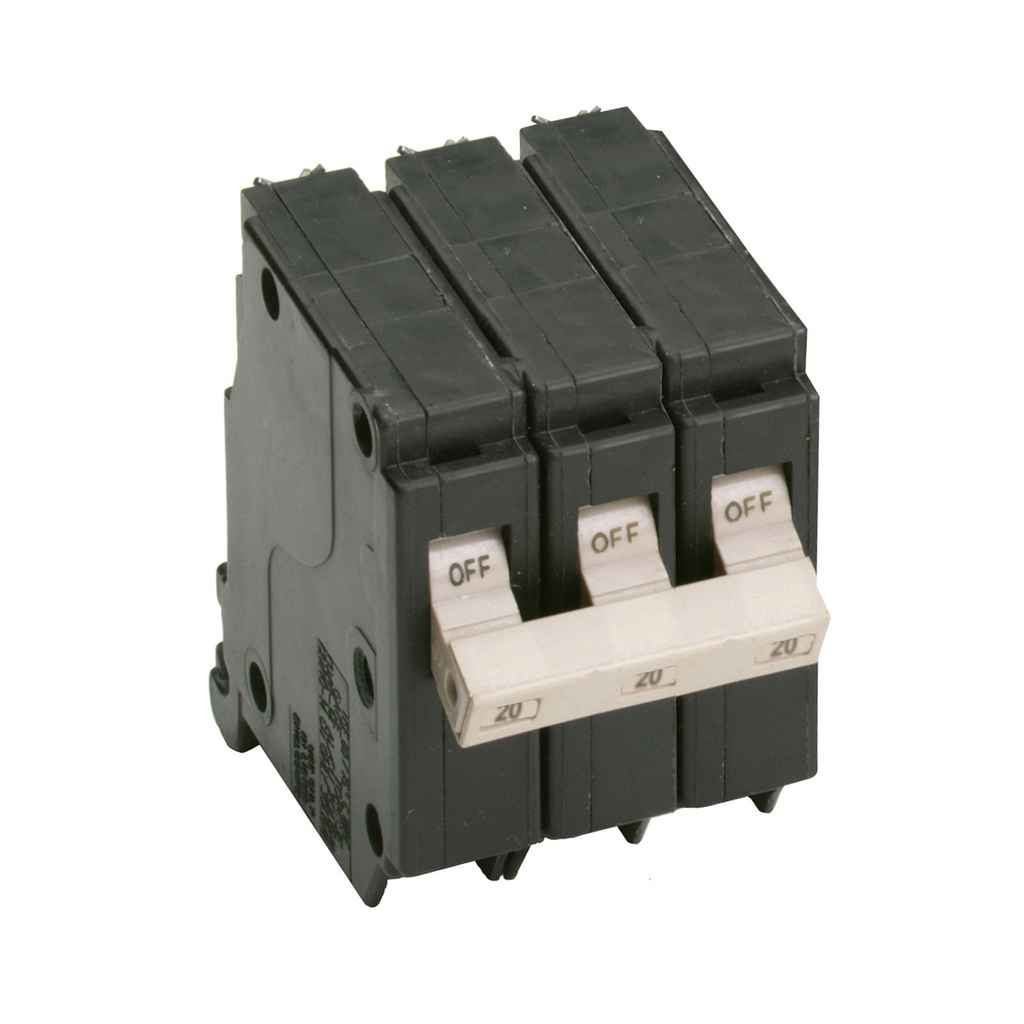
Dual function breakers are more sensitive to wiring errors than a standard breaker. Four issues cause the majority of nuisance trips:
Shared neutrals. Each dual function breaker needs a dedicated neutral from the breaker back to the panel neutral bar. Multiwire branch circuits (MWBC) that share a neutral between two circuits will trip a single-pole dual function breaker instantly. Use a two-pole dual function breaker listed for the shared-neutral (MWBC) application, or verify the circuit configuration before modifying it.
Neutral-to-ground contact downstream. Any accidental bond between the neutral and ground past the breaker — a nicked neutral touching a box, a reversed polarity device — looks like a ground fault to the GFCI side. If you suspect insulation resistance issues, have a qualified electrician perform insulation-resistance testing; sensitive equipment must be disconnected or isolated per the manufacturer's instructions before testing.
Switching loads with high inrush. Older refrigerator compressors, treadmills, and some vacuums can produce arc signatures that borderline-trip AFCI electronics. Newer AFCI designs may improve immunity to unwanted trips, but compatibility and wiring issues can still occur.
Backstab connections. Push-in receptacle connections create intermittent series arcs that AFCIs will detect — which is exactly what AFCIs are for, but the original symptom reads as a nuisance trip. Terminate on screws. See miniature circuit breakers for the full range of compatible options.
How do you test and diagnose a dual function breaker?
Three test paths:
Monthly button test. Press the TEST button on the breaker face. The breaker should trip; the exact trip position varies by manufacturer and model — consult the installation sheet for the specific reset procedure. Reset by following the manufacturer's instructions (typically push to OFF, then ON). This verifies the electronics are functional but does not test the circuit wiring.
Plug-in GFCI tester. A standard three-light tester with a GFCI trip button, plugged into any receptacle on the circuit, confirms end-to-end GFCI function. Will not test AFCI function.
Trip indication. Many current Eaton, Square D, Siemens, and Leviton dual function breakers include an LED or indicator that flashes a code after a trip, distinguishing GFCI, series arc, parallel arc, ground fault, and self-test failure. Indicator behavior and code charts vary by manufacturer and model — keep the installation sheet with the panel directory.
For deeper diagnosis — intermittent trips, high ambient leakage, or suspected shared neutrals — use a clamp meter around the hot and neutral together (reads imbalance). For insulation-resistance testing, engage a qualified electrician and ensure sensitive equipment is disconnected or isolated per the manufacturer's instructions before testing.
Dual function breaker vs dual function receptacle: which should you spec?
Dual function receptacles exist — such as the Leviton AFRBF (AFCI-only blank-face device) or the Leviton AGRBF (dual function AFCI/GFCI blank-face model) — and provide protection at the point of use. They cost less per device than a dual function breaker. The tradeoff is scope of protection.

A dual function breaker protects the entire branch circuit — the home run from panel to first outlet, all devices, and all wiring between them. If a staple is driven into the home run during a later remodel, the breaker catches it.
A dual function receptacle protects only itself and anything wired to its LOAD terminals. The upstream cable between panel and receptacle has no AFCI or GFCI protection. For a code-compliant install under NEC 210.12, a receptacle-based approach is permitted only under specified installation arrangements — verify the conditions with your AHJ before specifying this path.
Spec the breaker for new construction, for any circuit where the panel has room, and for any application where whole-circuit protection matters. Spec the receptacle for retrofits into panels that don't accept dual function breakers (older load centers, commercial panelboards without CAFCI-listed breakers available). Review GFCI and specialty receptacles for the receptacle-based path.
How do dual function breaker brands compare on price and availability?
Four brands dominate the residential dual function market in the US: Eaton (CH and BR series), Square D (QO and Homeline), Siemens (QP), and Leviton (load center line). Each is panel-specific — the choice is usually made for you by the installed panel.
Eaton CH is the premium residential line with a broad selection of available breaker types and configurations. Eaton BR is the value tier — same brand, different bus stab, broader distribution. Leviton's dual function breakers only fit Leviton load centers but are competitively priced inside that ecosystem. The LB120-DFT is not a smart breaker and does not itself provide circuit-level monitoring. See the full range of specialty breakers we carry.
Choose Eaton when:
- The installed panel is Eaton CH or Eaton BR (Cutler-Hammer lineage)
- You need the broadest selection of amperage and pole configurations
- You want plug-on neutral construction for faster rough-in
- You're standardizing a service truck's breaker stock across residential jobs
Choose Leviton when:
- The installed panel is a Leviton load center
- You want a single-vendor stack (panel, breakers, receptacles, switches)
- Circuit-level monitoring is part of the spec (note: requires a compatible smart-panel system; the LB120-DFT breaker itself does not provide monitoring)
| Brand/Series | UL Standards | Panel Compatibility | Best For | List Price Tier |
|---|---|---|---|---|
| Eaton BR-N115DF | UL 943 (Class A GFCI), UL 1699 (CAFCI) | Eaton BR load centers, pigtail neutral | Value-tier residential retrofits and new construction | Value |
| Eaton CH Series | UL 943, UL 1699 | Eaton CH load centers only | Premium residential, broad breaker type selection | Mid |
| Eaton BR-N115AF (AFCI-only reference) | UL 1699 (CAFCI) | Eaton BR load centers | AFCI-only circuits where GFCI is provided downstream | Value |
| Leviton LB120-DFT | UL 943, UL 1699 | Leviton load centers, plug-on | All-Leviton panel stacks; does not itself provide circuit monitoring | Mid |
Need the dual function path for your next panel schedule? Shop combination AFCI/GFCI dual function breakers at ZenSupply — Eaton and Leviton in stock, with full brand pages for Eaton and Leviton if you need to cross-reference compatible load centers and devices.