


Eaton Electrical Panel Board Buying Guide: Sizing, Ratings & Series Comparison
Products in this guide
Eaton Electrical Panel Board Buying Guide: Sizing, Ratings & Series Comparison
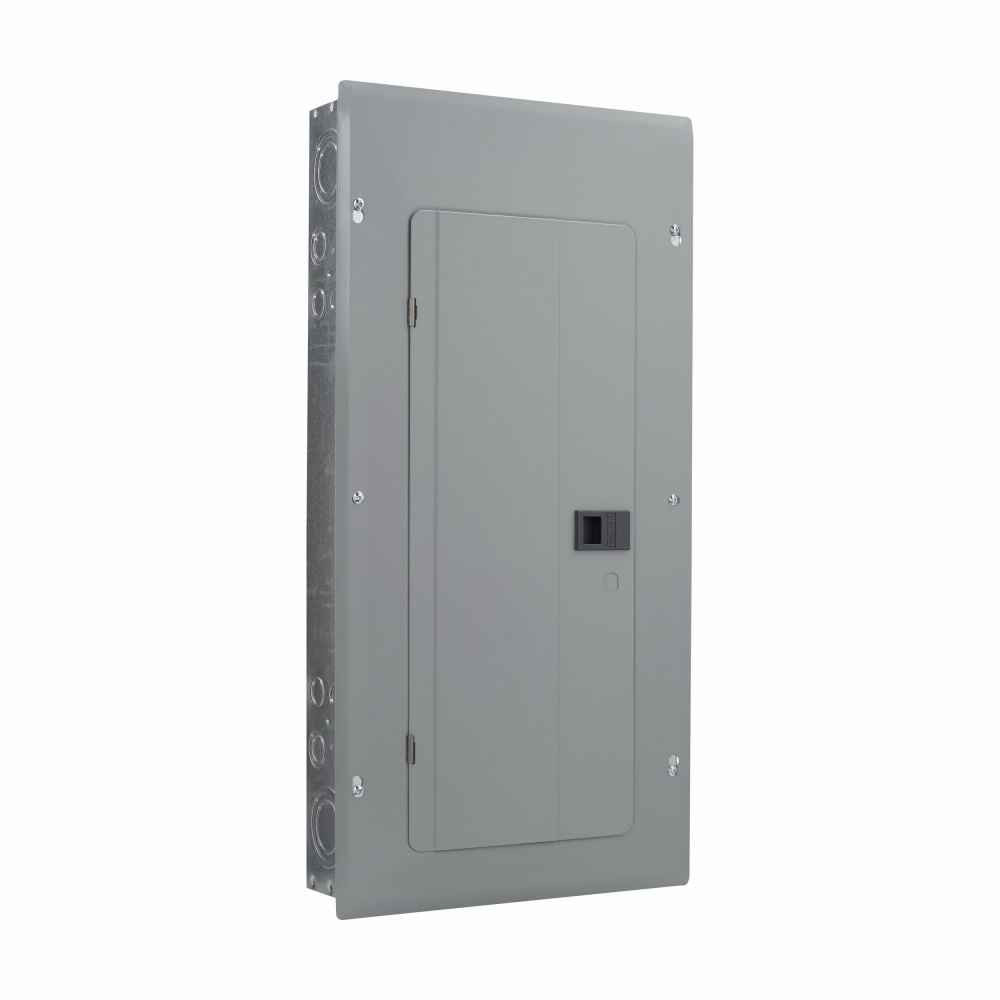
At a Glance
- Eaton CH series (Cutler-Hammer legacy) — premium residential/light commercial loadcenters, 22 kAIC bus, copper bus standard. Spec when you want CH-only 3/4" breakers and tighter fit.
- Eaton BR series — value-tier loadcenters, 10-25 kAIC bus, aluminum or copper bus, plug-on neutral models available. Broadest 1Ø and 3Ø convertible lineup we stock.
- Eaton Series C molded-case breakers (F/K/N frame) — for feeder and main-breaker duty above 225 A, with interchangeable rating plugs on K-frame.
- Size the panel to the calculated load per NEC Article 220, then verify the assembly SCCR meets or exceeds available fault current at the line terminals — UL 67 listed, with the assembly SCCR marked per NEC 408.6.
- NEMA 1 for indoor dry, NEMA 3R for outdoor/rain-tight service entrance, NEMA 12 for indoor dust/oil industrial.
What is an electrical panel board and how does it differ from a load center?

A panel board is a UL 67-listed assembly of buswork, overcurrent devices, and a metal cabinet that distributes power from a service or feeder to branch and feeder circuits. NEC Article 408 governs their construction, wiring space, and working clearances.
"Load center" is the trade name for a UL 67 panelboard built to a lower price point — typically residential and light commercial, with 10-22 kAIC bus ratings, aluminum or copper bus, and plug-in breakers. Commercial panelboards (Eaton Pow-R-Line, Square D NQ/NF, Siemens P1/P2 in the broader market) use bolt-on breakers, higher SCCR, and deeper wiring gutters.
For most 100-225 A commercial and multi-family service, an Eaton main breaker panel from the BR or CH family is what actually ships. True Pow-R-Line panelboards are quoted and lead-time driven.
How do you size an electrical panel board for a commercial building?

Three inputs drive the sizing decision: calculated load, service voltage/phase, and required circuit count plus 25% spare capacity for future.
Run the load calc per NEC 220 (general lighting, receptacles, motors with the 125% largest-motor factor, HVAC, and any continuous loads at 125%). Round up to the next standard bus rating: 100, 125, 150, 200, 225, 400, 600, 800, or 1200 A. For single-phase 120/240 V service under 400 A, a loadcenter like the Eaton Type CH 200A main breaker loadcenter covers most tenant and small-commercial applications. For 208Y/120 V three-phase, step up to a BR three-phase convertible or a Pow-R-Line panelboard.
Circuit count: total your poles, add ~25% spare, and pick a panel with that many spaces. NEC 408.54 no longer caps a panelboard at 42 overcurrent devices — that ceiling was deleted in the 2008 edition, and a panel is now limited to the number of poles it is listed for. Plenty of AHJs still design to 42, so confirm locally. For main-lug feeder distribution downstream, a main lug panel like the Eaton BR Series 400A main lug loadcenter handles the higher amperage without duplicating overcurrent protection already provided upstream.
Main breaker vs. main lug vs. sub panel — which do you need?
A main breaker panel has an integral disconnect and overcurrent device at the top of the bus. Use it as service equipment (NEC 230.70(A)(1) requires the service disconnect at a readily accessible location outside the building, or inside nearest the point of entrance of the service conductors) or anywhere you need a single-motion shutoff for the whole panel.
A main lug panel has lugs only — no main breaker. It's fed from upstream overcurrent protection sized to the panel's bus rating. Use it for downstream distribution where the feeder breaker already protects the bus, or as one of up to six grouped service disconnects, which NEC 230.71 (2020 and later editions) requires be installed in separate enclosures.
A sub panel is any panel downstream of the main service disconnect. Key requirement: the neutral must be isolated from the equipment ground per NEC 250.24(A)(5). Pull the main bonding jumper and land the EGC on a separate ground bus. For sub-feed applications, browse our sub panels category.
Need a panel now? Browse our panel boards & load centers inventory — Eaton CH and BR loadcenters in stock across 100 A to 400 A, single and three-phase.
What do SCCR, AIC, NEMA enclosure, and voltage ratings mean on a panel board?
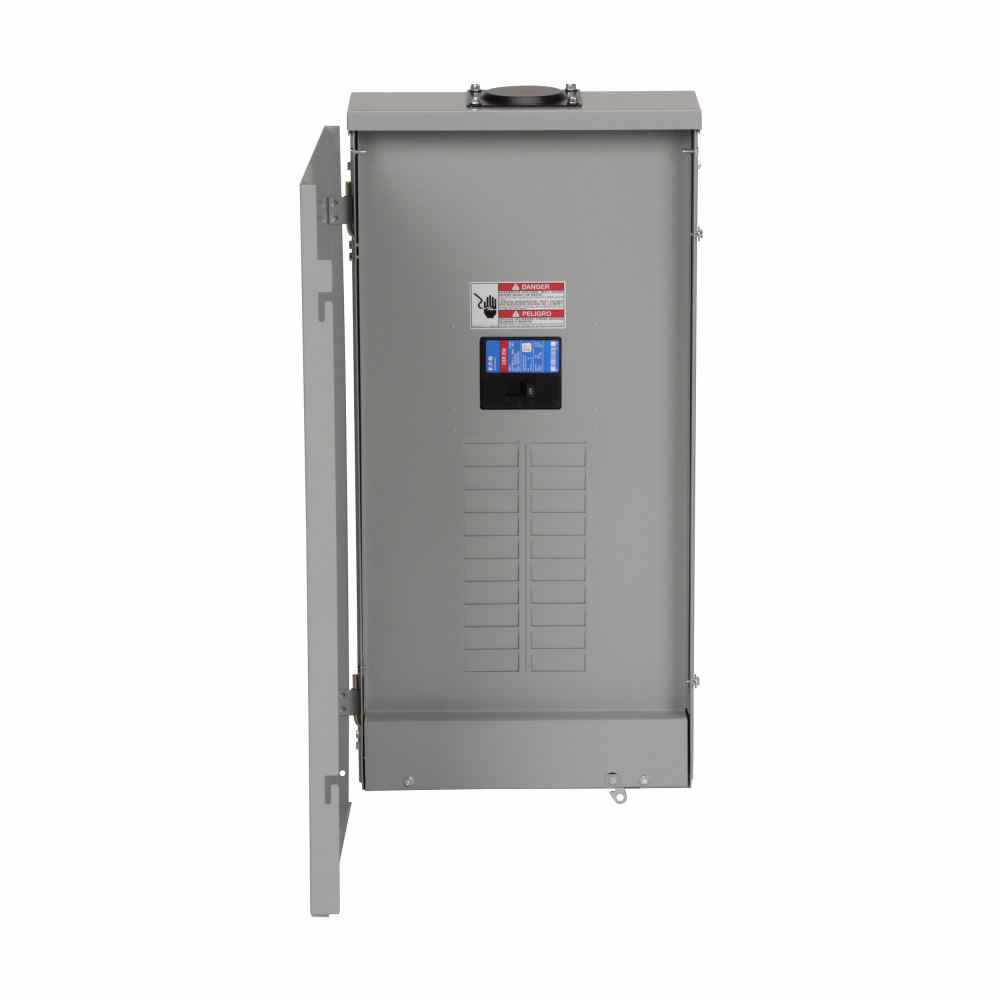
AIC (Amps Interrupting Capacity) is a rating on the individual overcurrent device — the maximum fault current the breaker can interrupt without failing. Eaton BR breakers are typically 10 kAIC standard; CH breakers 22 kAIC; Series C molded-case breakers from 25 to 200 kAIC depending on frame and interrupt suffix (GHB, FD, HFD, etc.).
SCCR (Short-Circuit Current Rating) is the rating on the assembly — the panelboard as a system. It's the lower of the bus bracing rating and the interrupt rating of the installed devices. Per NEC 110.10 and 408.6, the SCCR at the line terminals must equal or exceed the available fault current from the utility (get this from the POCO). Common loadcenter assembly SCCRs are 10, 22, 25, 42, and 65 kAIC.
NEMA enclosure: NEMA 1 = indoor, general purpose. NEMA 3R = outdoor, rain-tight (service entrance). NEMA 12 = indoor industrial, dust and dripping oil. NEMA 4X = washdown/corrosive, stainless.
Voltage: 120/240 V 1Ø 3W for residential and small commercial; 208Y/120 V 3Ø 4W for most multi-tenant and light commercial; 480Y/277 V 3Ø 4W for larger commercial and industrial with lighting/HVAC at 277 V. The bus, breakers, and neutral all have to be rated for the system voltage. Feeder and main-breaker duty above 225 A generally means Eaton molded case circuit breakers in F, K, or N frame.
How does the Eaton CH series compare to the Eaton BR series?
Choose Eaton CH when:
- You want a 22 kAIC bus rating and copper bus in every SKU
- The install is space-constrained — CH breakers are 3/4" wide, so a 20-space cabinet gets you 40 poles
- The customer or spec sheet calls for "Cutler-Hammer CH" (same product — Eaton kept the CH brand after acquiring Cutler-Hammer)
- You need CH-family AFCI/GFCI plug-on-neutral breakers, which snap directly onto the PON bar without pigtails
Choose Eaton BR when:
- Budget is the driver — BR is the value tier and covers most tenant, small commercial, and multi-family panel duty
- You need 1" plug-in breakers with wider third-party compatibility (BR-classified breakers are made by several manufacturers)
- You need a three-phase convertible loadcenter — Eaton's BR three-phase lineup (100-225 A) is deeper than the CH three-phase catalog
- You want 25 kAIC bus with plug-on neutral — the newer BR PON series like the Eaton Type BR Plug-On Neutral 200A main breaker loadcenter hits the 25 kAIC rating
Square D (QO/Homeline), Siemens (P1/P2, PL/ES), and GE (PowerMark Gold — now ABB) are common on spec sheets and existing sites. We don't stock those brands — if you're replacing a Square D QO or a Siemens loadcenter and want to stay same-brand for breaker compatibility, source through the manufacturer's distributor. If you're open to swapping the panel, the Eaton CH or BR equivalent typically ships faster from our shelf.
How do meter sockets, disconnects, and service-entrance gear pair with the panel?

For a single-tenant service, the standard stack is: utility service drop → meter socket → main-breaker loadcenter (or meter-main combo). The Eaton 200A single-phase meter socket with lever bypass is the workhorse for single-family and small commercial services — lever bypass lets the POCO pull the meter under load.
For multi-tenant, use a meter stack (group metering module). Eaton's 35MM and 37MM modular meter stacks handle 3-8 tenant positions off a common 800-1200 A horizontal bus, single or three-phase. Downstream tenant panels are typically 100-125 A main-breaker loadcenters.
Where the meter and main are combined, spec a meter-main like the Eaton 200A meter main breaker in NEMA 3R — one enclosure, one set of penetrations, satisfies NEC 230.70 disconnect location outdoors. For separate safety disconnects downstream of the panel, we stock safety switches in fusible and non-fusible configurations.
Do commercial panel boards require surge protection and AFCI/GFCI?
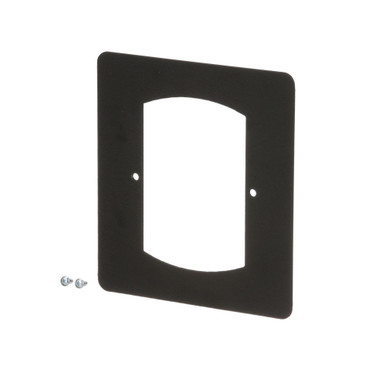
NEC 230.67 (2020 and later editions) requires a Type 1 or Type 2 SPD on dwelling-unit services. Commercial services aren't code-mandated but are a spec-driven best practice, particularly for facilities with sensitive electronics, VFDs, or life-safety loads. Panel-mount Type 2 SPDs like the Eaton CHSPT2ULTRA install as a two-pole plug-on device — the Eaton CHSP Type 2 flushmounting kit handles the cabinet penetration cleanly. Browse the full panel-mount SPDs selection for CH- and BR-compatible options.
AFCI is required by NEC 210.12 on most 120 V, 15/20 A dwelling-unit branch circuits. GFCI is required by 210.8 in kitchens, baths, garages, outdoors, and commercial locations including rooftops and within 6 ft of sinks. Combination AFCI/GFCI breakers are available in both CH and BR families and install directly into plug-on-neutral panels without pigtails.
What NEC code, labeling, and installation requirements apply to commercial panels?
Working clearance: NEC 110.26 requires 3 ft depth of clear working space in front of any panel operating at up to 150 V to ground (Condition 1). Higher voltages and equipment on both sides increase the required depth. Width is the greater of 30" or the panel width, and headroom is 6.5 ft.
Panel labeling: NEC 408.4 requires every circuit and modification legibly identified at the panel. NEC 110.16 requires the arc-flash warning label on any panel likely to require examination while energized. NEC 110.24 requires the available fault current and date calculated to be field-marked on service equipment.
Grounding and bonding: at service equipment, bond neutral to enclosure via the main bonding jumper (NEC 250.24). At sub panels, keep neutral isolated and bring a separate EGC. All grounding conductors terminate on a listed ground bus.
Torque: NEC 110.14(D) requires terminations to be torqued to the manufacturer's listed values with a calibrated tool. Eaton publishes torque specs on the panel schedule label — follow them, don't guess.
How do the Eaton loadcenter families compare?
| Series | Bus SCCR | Bus Material | Best For | List Price Tier |
|---|---|---|---|---|
| Eaton CH 200A Main Breaker | 22 kAIC | Copper | Premium residential and light commercial where CH breakers are specified | High |
| Eaton BR 200A Main Breaker | 10-22 kAIC | Aluminum or Copper | General-purpose tenant and small commercial main-breaker service | Value |
| Eaton BR PON 200A | 25 kAIC | Copper | New construction where PON AFCI/GFCI breakers eliminate pigtails | Mid |
| Eaton BR 3Ø Convertible 100A | 10-22 kAIC | Aluminum | 208Y/120 V three-phase multi-tenant and light commercial | Mid |
| Eaton BR 400A Main Lug | 22 kAIC | Aluminum | Downstream distribution where upstream OCPD protects the bus; NEMA 3R | Mid |
SCCR values above are typical for the family — verify the label on the specific catalog number, which reflects the installed breaker interrupt rating and any series-combination listing.
Ready to spec the service? Shop commercial panel boards & load centers to pair Eaton CH, BR, and Series C molded-case gear with meter sockets, SPDs, and safety switches.