


Mechanical Push Button Lockset Knob, Entry: Commercial Buying Guide
Products in this guide
At a Glance
- Kaba Simplex L1000 — the spec-standard mechanical pushbutton knob for IT closets, employee entrances, and utility rooms. No batteries, no wiring.
- Lockey 2210 / 2835 — value-tier mechanical keyless with single or double combination; 2835 lever variant is ADA-compliant.
- Alarm Lock Trilogy DL2700 — electronic keypad alternative when you need multiple user codes; Grade 1 per A156.2.
- TownSteel CRX Series — heavy-duty, ligature-resistant cylindrical locksets (e.g. CRX-K-81 entry) for institutional and behavioral-health openings.
- For ADA §404.2.7 compliance on required accessible routes, spec a lever variant — knob-style pushbutton locks do not meet the lever-operable requirement.
What Is a Mechanical Push Button Lockset (Knob, Entry Function)?
A mechanical pushbutton lockset is a standalone keyless lock with an integrated combination keypad on the exterior trim. Press the correct sequence, turn the knob, and the latch retracts. No batteries, no wiring, no server.
Entry function means the exterior knob is normally locked and requires the code to enter. The interior knob is always free-egress (turn to exit — no code required), which is what building and life-safety codes demand for occupiable rooms. Most units include a key override cylinder for lockout recovery and master-key integration.
These locks fit standard 161 door prep and drop into the same cross-bore as a conventional cylindrical lock, which makes them a clean retrofit for openings where you want to eliminate mechanical key distribution without moving to networked commercial mechanical pushbutton locks or full electronic and keyless locks.
How Does an Entry-Function Mechanical Pushbutton Lock Work?
The keypad drives a purely mechanical clutch. When the correct code is entered, the clutch engages the exterior knob to the latch retractor. Turn the knob and the door opens. Release the knob and the clutch disengages — the lock re-secures automatically. No power source in the chain.
Because the mechanism is mechanical, code changes are done manually at the lock (usually via a change key or a disassembly procedure documented in the manufacturer's instructions). There is no audit trail, no scheduled access, and no remote management. That's the trade — simplicity and zero infrastructure in exchange for feature poverty.
What's the Difference Between Knob and Lever Pushbutton Locks?
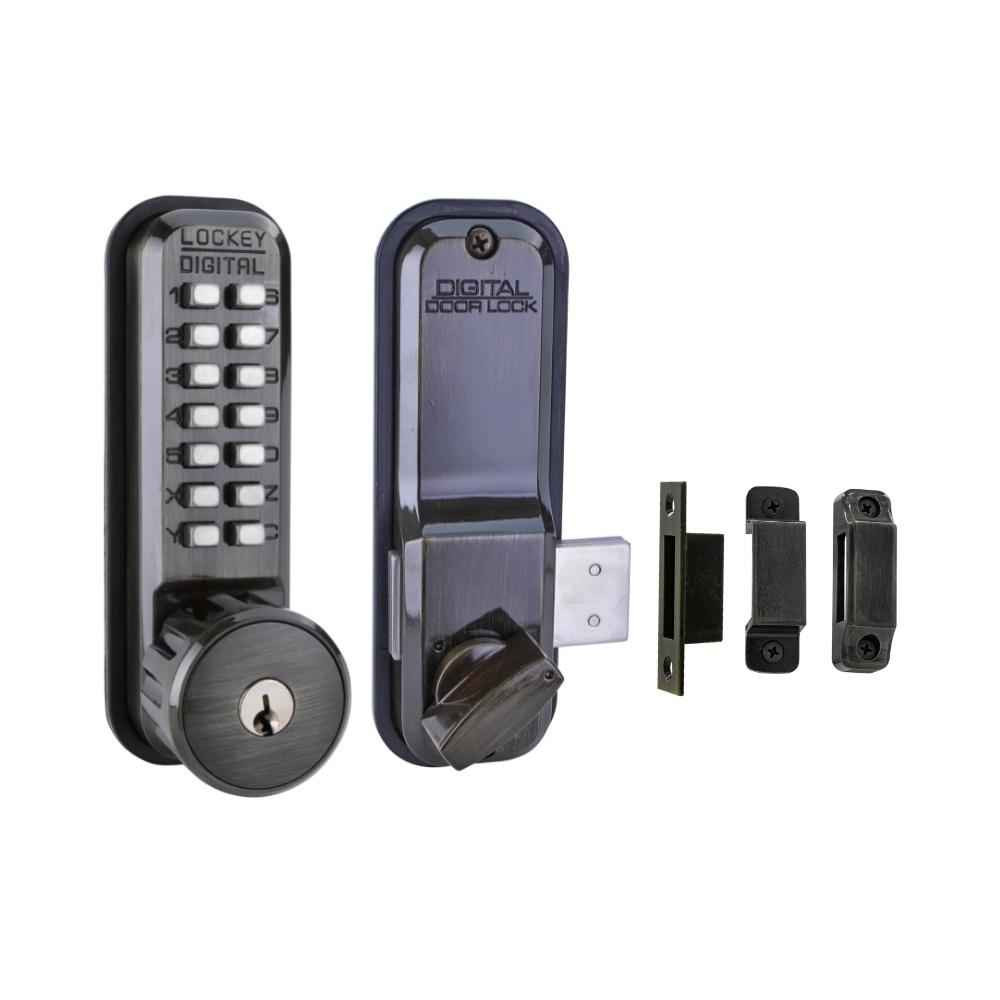
Two things: ergonomics and code compliance. Knob-style trim requires tight grasping and twisting, which fails ADA 2010 §404.2.7 on doors serving accessible routes. Lever-style trim satisfies the operability requirement.
Spec knob variants for utility closets, IT rooms, roof-access doors, and mechanical spaces — openings that aren't on an accessible route. Spec lever variants (Lockey 2835, Simplex L1000 lever configurations, TownSteel lever pushbuttons) anywhere the door serves the public or employees on a required accessible path.
Which Brands Make the Best Mechanical Pushbutton Entry Knob Locks?
Four brands dominate the specification landscape:
Kaba Simplex (dormakaba Simplex 1000) — the 1000 and L1000 series are the reference-standard mechanical pushbuttons. Heavy brass chassis, thousands of possible combinations, common on federal and institutional specs.
Lockey — value-tier mechanical keyless from a specialty manufacturer. The 2210 deadbolt, 2830 knob, and 2835 lever cover most light-to-medium commercial openings at a lower price point than Simplex.
Alarm Lock Trilogy — technically electronic (battery-powered keypad), but frequently cross-shopped against mechanical pushbuttons because it solves the same problem — keyless entry without wiring. The Alarm Lock Trilogy DL2700 gives you 100 user codes vs. one combination on a Simplex.
TownSteel CRX Series — heavy-duty, ligature-resistant cylindrical locksets for behavioral-health, correctional, and other institutional openings. Not a keyless pushbutton like the others here, but the go-to TownSteel line for high-abuse and anti-ligature specs. See the TownSteel CRX-K-81 entry lockset as the entry-function reference.
Choose Kaba Simplex when:
- The spec explicitly calls for a mechanical pushbutton with no power source
- You need a proven brass chassis for high-abuse openings
- Single shared combination is acceptable (staff-only spaces)
- You want the reference SKU that meets most institutional specs without RFI
Choose Lockey when:
- Budget matters and the opening is light-to-medium duty
- You need a mechanical deadbolt variant (2210, M210) for a gate or auxiliary application
- Double-combination for two user groups is required (2835DC)
- Marine-grade finish is needed for exterior or coastal exposure
Choose Alarm Lock Trilogy when:
- You need multiple user codes (up to 100 on DL2700, more on higher-tier models)
- An audit trail matters — jump to DL3000 or higher
- Battery replacement on a schedule is acceptable
- You want Grade 1 per A156.2 (800,000 cycles minimum) in an electronic package
Choose TownSteel CRX when:
- The opening is in a behavioral-health, correctional, or other institutional environment
- Ligature resistance is a requirement, not a nice-to-have
- You need a heavy-duty stainless cylindrical lockset rated Grade 1
- Function-specific trim (entry/office, classroom, storeroom, privacy) matters for the opening
Do Mechanical Pushbutton Knob Locks Meet ADA and Grade 1 Requirements?
ADA 2010 §404.2.7 requires hardware that is operable without tight grasping, pinching, or twisting. Knob-style trim does not comply on accessible-route doors. Lever-style pushbutton variants do. This is not a manufacturer question — it's a geometry question.
For BHMA cycle grade: cylindrical mechanical locks are certified under A156.2. Grade 1 = 800,000 cycles minimum, Grade 2 = 400,000, Grade 3 = 200,000. Kaba Simplex 1000/L1000 and most TownSteel keyless are certified Grade 1. Lockey products vary — verify the specific SKU against manufacturer documentation before you commit on a spec.
For fire-rated openings: Mechanical pushbutton locks are commonly listed as components for use in fire door assemblies tested to UL 10C. The lock must be labeled for fire-door use and paired with a labeled latch and appropriate strike; the assembly (door + frame + hardware) carries the fire rating, not the lock itself. Assembly ratings up to 3 hours depending on door and frame construction — verify the specific listing.
What Backset, Door Thickness, and Prep Do Pushbutton Knob Locks Require?
Standard cylindrical prep applies to all four major brands: 2-1/8" cross-bore, 1" edge bore, and either 2-3/4" (standard) or 2-3/8" (residential/narrow) backset. Simplex and Lockey ship with adjustable latches to cover both. Door thickness range typically 1-3/8" to 2" for standard variants; thick-door kits are available for openings up to 5" (Lockey EXTKIT).
Strike prep is standard ANSI 4-7/8" T-strike. If you're retrofitting over an existing cylindrical lock, you rarely need to modify the door. See lock parts and accessories for strikes, spindles, and latch replacements.
How Do You Change the Combination on a Kaba Simplex or Lockey Pushbutton Lock?
Kaba Simplex: partial disassembly. Remove the exterior housing, access the combination chamber, set the new pin/gate configuration, reassemble. Plan on 10–15 minutes per lock once you've done a few. Combinations use buttons 1–5 in any non-repeating sequence; you can also program "empty" (push-and-turn with no code) for daytime unlocked mode on some models.
Lockey: change-key procedure on most models — insert the change key, dial the new combination on the buttons, remove the change key. Faster than Simplex once you have the tool.
Alarm Lock DL2700: programmed from the keypad using the master code. Add or delete user codes without touching the chassis — the primary advantage over pure mechanical.
For openings where combination turnover is frequent (shared staff, contractor access, quarterly changes), the friction of physically disassembling a Simplex adds up. Consider the DL2700 or higher-tier electronic keypad locks instead.
Where Should You Install a Mechanical Pushbutton Entry Knob Lockset?
Best-fit applications: IT and telecom closets, janitorial rooms, roof-access doors, mechanical rooms, small back-of-house storage, employee-only break rooms, and utility spaces. Anywhere a single shared combination controls access to a low-turnover, staff-only opening and you want to eliminate key issuance.
Poor fit: high-turnover openings, tenant spaces, front doors on accessible routes (spec lever), and any application where audit trail or scheduled access matters. For those, jump to electronic and keyless locks.
How Kaba Simplex Compares to Lockey, Alarm Lock Trilogy, and TownSteel
Simplex is the incumbent. Solid brass chassis, mechanically robust, meets most institutional specs by name, and lasts decades with minimal maintenance. Downside: single combination, disassembly to change, and a meaningful premium over the alternatives.
Lockey undercuts Simplex on list price and offers configurations Simplex doesn't (surface-mount deadbolts, hookbolts for sliding gates, marine finishes). It's the right call when budget matters or the application is unusual. The trade is a lighter chassis and less institutional-spec presence.
Alarm Lock Trilogy DL2700 isn't mechanical — it's electronic — but it competes for the same specifier's attention. If you need more than one user code, or you want to add/remove codes without pulling the lock apart, the DL2700 wins on features. The trade is battery maintenance (3–5 years on 4 AA at low traffic; 1–2 years at medium traffic).
TownSteel sits outside the keyless-pushbutton comparison but earns a place on institutional specs: the CRX series is a heavy-duty, ligature-resistant cylindrical lockset for behavioral-health, correctional, and high-abuse openings. Choose it when anti-ligature safety and Grade 1 durability outrank keyless convenience — pair it with a separate access-control method if code-based entry is also required.
Speccing keyless locks for a project? Browse our mechanical pushbutton lock inventory — Simplex, Lockey, Alarm Lock, and TownSteel in stock with keying and finish options.
How to Spec and Order Your Pushbutton Entry Knob Lockset
Nail down these fields before ordering: (1) function — entry vs. passage vs. classroom vs. storeroom; (2) trim — knob or lever (ADA); (3) backset — 2-3/4" or 2-3/8"; (4) door thickness; (5) finish — 626 satin chrome is the workhorse, 605 polished brass and 613 oil-rubbed bronze for design-driven jobs; (6) key override — keyed alike, keyed different, or masterkey system; (7) IC prep if you're on an SFIC or LFIC system.
Comparison table below covers the four core options for entry-function keyless locks.
| Brand / Series | BHMA Grade | Cycle Rating | Best For | List Price Tier |
|---|---|---|---|---|
| Kaba Simplex 1000 / L1000 | Grade 1 (A156.2) | 800,000 minimum per A156.2 | Institutional spec-standard mechanical keyless; IT closets, utility rooms | High |
| Lockey 2210 | Grade 2 (verify SKU) | 400,000 minimum per A156.2 Grade 2 | Value-tier mechanical deadbolt; gates, auxiliary openings | Value |
| Lockey 2835 | Grade 2 (verify SKU) | 400,000 minimum per A156.2 Grade 2 | ADA-compliant lever, keyless mechanical; employee entries | Value |
| Alarm Lock Trilogy DL2700 | Grade 1 (A156.2) | 800,000 minimum per A156.2 | Electronic keyless w/ 100 user codes; storage, break rooms | Mid |
| TownSteel CRX-K-81 (Entry/Office) | Grade 1 (A156.2) | 800,000 minimum per A156.2 | Heavy-duty, ligature-resistant cylindrical; institutional, behavioral health | High |
Need help matching a spec to a live SKU or building a keyed-alike system across multiple openings? Shop mechanical pushbutton knob locks at ZenSupply — or contact our team for volume quotes, keying schedules, and finish matching across brands.