


Panel Board Buying Guide: How to Spec Commercial Panelboards Right
Posted by ZenSupply Electrical Team on Jun 17th 2026
At a Glance
- Square D and Eaton dominate commercial panelboard specs — both meet UL 67 and NEC Article 408 requirements.
- Main breaker panels are required where the panel is the service disconnect; main lug panels are for downstream sub-feeds with upstream protection.
- Size to 125% of continuous load per NEC 215.3 / 230.42, and add 20–25% spare capacity for future circuits.
- NEMA 1 indoor, NEMA 3R outdoor/rain-tight, NEMA 12 dust/oil — pick by environment, not by price.
- Match breakers to the panel bus type — Eaton BR ≠ Eaton CH, Square D QO ≠ Square D Homeline.
What Is a Panel Board? (And How It Differs From a Load Center?)
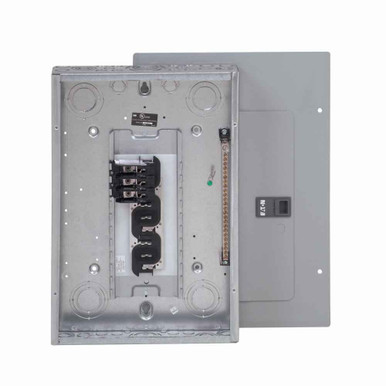
A panel board is the central distribution point that takes incoming service or feeder power and splits it into branch circuits, each protected by its own overcurrent device. UL 67 governs the listing; NEC Article 408 governs installation. Commercial panelboards are built for higher short-circuit current ratings (SCCR), heavier copper or aluminum bus, and modular breaker arrangements suitable for three-phase loads.
"Load center" is the residential and light-commercial cousin — same basic function, but typically single-phase 120/240V, lower interrupting ratings (often 10 kAIC), and a narrower bus. If you're feeding a multi-tenant building, a commercial HVAC system, or anything three-phase, you're spec'ing a panelboard. Browse our full panel boards & load centers catalog and broader distribution equipment inventory to compare configurations.
Main Breaker vs Main Lug Panels: Which Should You Spec?
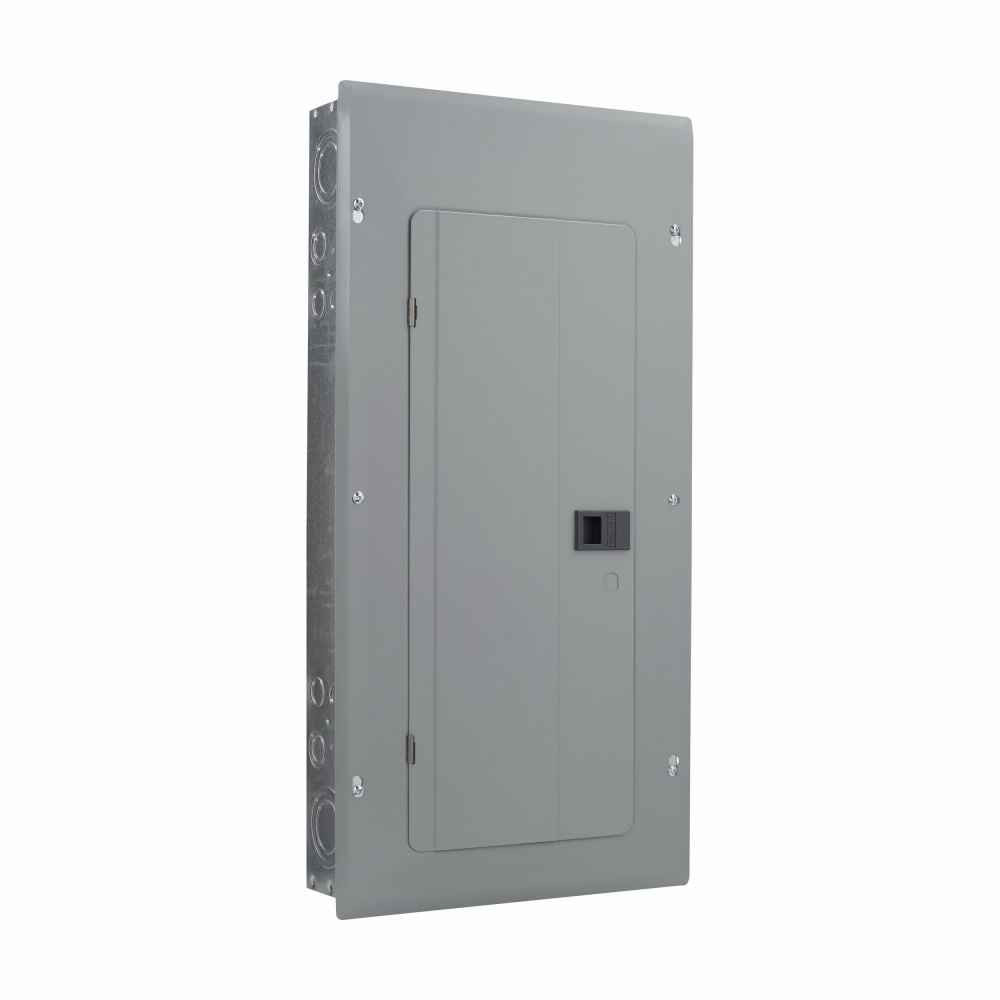
A main breaker panel has an integral overcurrent device at the top of the bus. It serves as the service disconnect when the panel is the first point of utilization from the utility, or any time code requires a single disconnecting means at the panel. Spec it for service entrance applications and any installation where NEC 230.70 requires a readily accessible disconnect at the panel itself.
A main lug panel has no integral main — power lands directly on the bus lugs. It's used downstream of an upstream breaker (service disconnect, transformer secondary, or feeder breaker in a switchboard) that provides the required overcurrent protection. Shop main breaker panels or main lug panels depending on where the panel sits in the distribution hierarchy.
How Do You Size a Commercial Panel Board?
Three numbers drive the spec: amperage, voltage/phase, and circuit count. Calculate connected load per NEC Article 220, then size the bus and main to at least 125% of continuous load. Common commercial bus ratings: 100A, 125A, 150A, 200A, 225A, 400A, and 600A. Voltage configurations are typically 120/208Y three-phase four-wire (most common in commercial) or 277/480Y three-phase four-wire (large commercial/industrial).
Circuit count matters as much as amperage. A 42-circuit panel is the common commercial ceiling per the legacy "42-circuit rule," though current NEC editions allow larger configurations when listed. Plan for 20–25% spare poles for future loads. If a single panel can't carry the full load, split into a main breaker panel feeding downstream sub panels, and stock the appropriate breaker box accessories (filler plates, ground bars, neutral kits).
Need a panelboard now? Browse our commercial main breaker panel inventory — UL 67 listed, in-stock from Square D and Eaton.
What NEMA Enclosure Rating Do You Need?
Pick the enclosure by environment, not by what's cheapest on the shelf:
- NEMA 1 — indoor, dry, conditioned space. Standard commercial back-of-house, electrical rooms, mechanical closets.
- NEMA 3R — outdoor, rain-tight. Service entrance on exterior walls, rooftop equipment, exterior gear yards. Shop NEMA 3R enclosures.
- NEMA 12 — indoor, dust-tight, drip-proof. Manufacturing, food processing, dusty industrial environments. Often spec'd alongside control panel enclosures.
If the panel will see washdown, corrosive atmospheres, or hazardous locations, step up to NEMA 4, 4X, or hazardous-rated equivalents — and verify the panelboard itself is listed for that environment, not just the enclosure.
How Do You Match Breakers to Your Panel?
Breaker compatibility is panel-family-specific. Mixing the wrong breaker into the wrong bus is a UL listing violation and a safety hazard. The rules:
- Square D QO takes QO breakers; Square D NQ/NF commercial panelboards take their respective breaker series. Homeline is residential and not interchangeable with QO.
- Eaton BR takes BR-series breakers; Eaton CH takes CH-series breakers. They are not interchangeable.
For branch protection up to ~150A, use miniature breakers (MCBs). For larger feeders and high-AIC requirements, use molded case breakers (MCCBs) with frame sizes matched to the panel — see the full circuit breakers catalog for series-specific options.
How Do Square D and Eaton Compare for Commercial Panelboards?
Choose Square D when:
- Spec calls for QO or NQ/NF series — these are the most commonly specified commercial panelboards in North American institutional and commercial work.
- You need broad availability of matching breakers from local distribution.
- Project standards require Schneider Electric's PowerPact MCCB ecosystem for feeders.
- Long-term parts and AFCI/GFCI breaker variety matter for tenant fit-outs.
Choose Eaton when:
- The application calls for the CH series (premium copper bus, tighter wire-bending space) or BR series (value-tier commercial/light-commercial).
- Pow-R-Line switchboards or Pow-R-Xpress convertible kits simplify field configuration between main breaker and main lug builds.
- You want flexibility to convert between main lug and main breaker in the field without restocking — Pow-R-Xpress kits are designed for this.
- Project specs reference Eaton's BJ, FD, or GHB frame MCCBs upstream.
For specialty applications — AFCI, GFCI, dual-function, shunt-trip — review the specialty breakers catalog before finalizing the panel schedule.
| Brand/Series | Bus Type | Typical AIC Range | Best For | List Price Tier |
|---|---|---|---|---|
| Square D QO / NQ / NF | Copper or tin-plated aluminum | 10–65 kAIC | Spec-driven commercial, institutional, multi-tenant | $$$ |
| Eaton Type CH | Copper bus | 22–65 kAIC | Premium commercial, tight wire-bending applications | $$$ |
| Eaton BR Series | Aluminum bus | 10–22 kAIC | Value-tier commercial, light commercial, tenant fit-out | $$ |
| Eaton Pow-R-Xpress Convertible (225A) | Field-convertible | 22–42 kAIC | Projects needing main breaker/main lug flexibility | $$$ |
What Service Entrance, Disconnect, and Surge Add-Ons Should You Plan For?
A panelboard rarely ships alone on a commercial project. Service entrance installations typically need an upstream or integral disconnect — review safety switches for fusible and non-fusible options. Panel-mounted surge protection is increasingly common (and required by some jurisdictions for dwelling-unit services per recent NEC cycles); see panel mount SPDs for Type 1 and Type 2 devices.
Don't forget meter sockets, transfer switches if there's a generator, and feeder breakers sized for the panel main. Coordinate the full one-line before ordering — back-ordered service entrance gear has killed more commercial schedules than any other electrical category.
What's the Installation Checklist for Grounding, Bonding, and Code?
Three rules separate a code-passing install from a callback:
- Service vs. sub-panel bonding. Neutral and ground bond at the service disconnect only. Sub-panels keep neutral isolated from ground — install a separate equipment ground bar.
- Grounding electrode system. Tie to building steel, water pipe (within 5 feet of entry), and supplemental electrodes per NEC 250.50–250.68. Stock ground rods & clamps sized to the service.
- Bonding jumpers. Main bonding jumper at the service, equipment bonding jumpers across concentric/eccentric knockouts and expansion fittings. Use listed bonding jumpers sized per NEC Table 250.102(C)(1).
Verify SCCR at the point of installation matches or exceeds available fault current — the utility provides this number, and it must be marked on the panel per NEC 110.24 for service equipment.
Ready to spec? Shop commercial main breaker panels at ZenSupply — Square D and Eaton in stock, with matching breakers, accessories, and service entrance gear ready to ship.