


Commercial Transfer Switches Buying Guide: Automatic vs Manual (ATS vs MTS)
Products in this guide
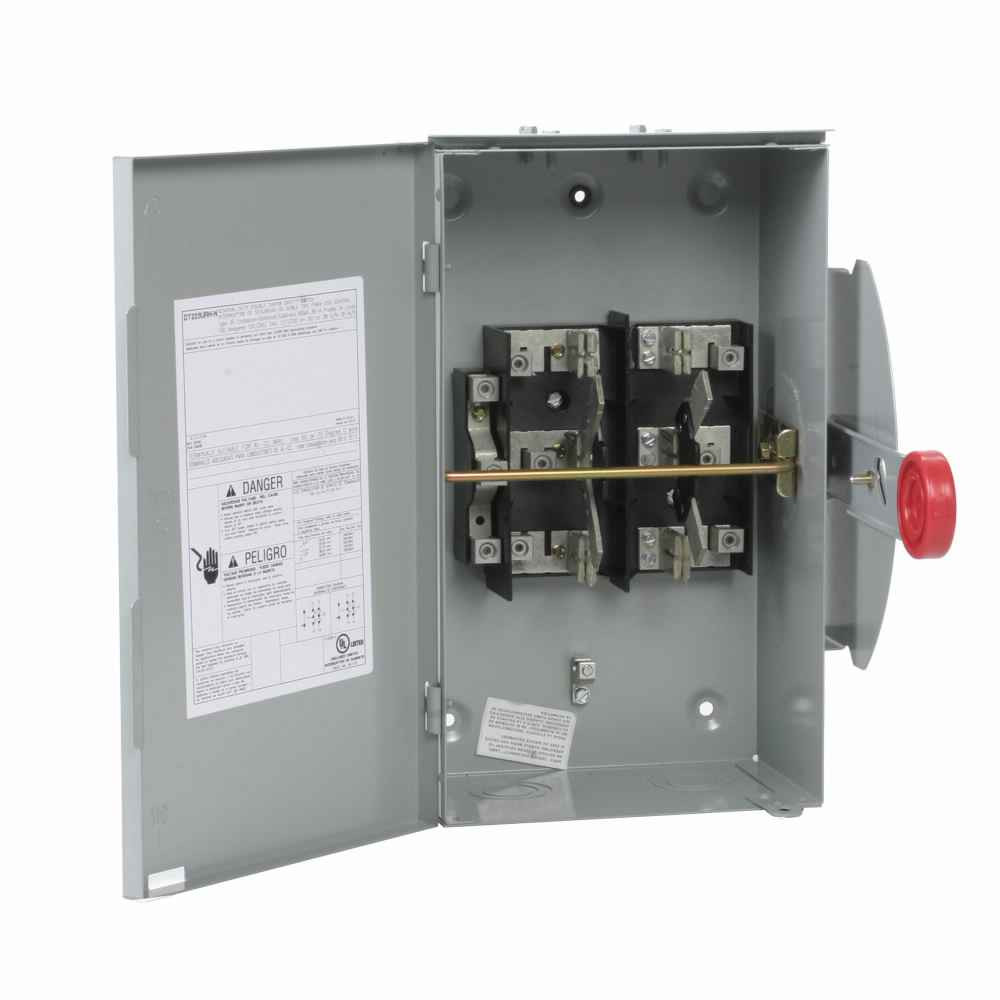
At a Glance
- Eaton is the sellable spec choice in this guide — ATC-series controllers and Pow-R-Xpress distribution gear carry the broadest in-stock depth across our distribution equipment inventory.
- ATS (automatic) is required where life-safety or legally required standby loads must re-energize within code-mandated time limits. MTS (manual) is acceptable only for optional standby per NEC Article 702.
- UL 1008 is the governing listing for transfer switch equipment — specify it or the AHJ will reject the submittal.
- Service-entrance rated switches integrate the main disconnect and eliminate a separate service disconnect upstream — faster installs, fewer enclosures.
- Open transition is the default; closed transition (make-before-break) is specified when a momentary parallel is acceptable to avoid load dropout.
What is a transfer switch and how does it work?
A transfer switch connects a load to one of two power sources — normal utility and an alternate source, typically an engine-generator — and prevents both sources from being connected to the load simultaneously. The mechanical interlock is the entire point of the device: paralleling utility and generator through anything less than a listed closed-transition mechanism is a code violation and a safety hazard.
Inside the enclosure you have two sets of main contacts (one per source), an operating mechanism that drives them, and — on automatic units — a controller that monitors utility voltage and frequency, signals the generator to start, waits for the generator to reach stable output, and commands the transfer. On return, the controller runs a retransfer sequence with a cooldown.
Specify to UL 1008. That listing covers withstand and closing ratings (WCR), overcurrent protection coordination, and endurance — the parameters your AHJ will look for.
What is the difference between an automatic and manual transfer switch?
An automatic transfer switch (ATS) senses loss of utility, starts the generator, and transfers load without human intervention — typically within 10 seconds for legally required standby and much faster for emergency systems. A manual transfer switch (MTS) requires an operator to physically rotate a handle or operate a breaker pair after starting the generator by hand.
For life-safety loads under NEC Article 700 (emergency) and Article 701 (legally required standby), automatic transfer is effectively mandatory because of the 10-second and 60-second transfer time limits those articles impose. MTS is only appropriate for Article 702 optional standby — convenience loads where downtime is tolerable.
Choose Eaton when:
- You need a single-source spec covering the generator-adjacent gear, upstream distribution, and the ATC-series controller family in one submittal.
- The project uses Eaton Pow-R-Xpress panelboards or BR/CH loadcenters downstream — bus and lug compatibility simplify the install.
- You want a UL 1008 listed solution with Eaton's heavy-duty DH heavy-duty safety switch framework behind the transfer mechanism for bypass or isolation requirements.
- Service-entrance rating is required and you want the main disconnect integrated — Eaton offers SE-rated configurations across the ATC product line.
How do I size a transfer switch for my generator and load?
Three numbers drive the sizing: continuous load current, available fault current at the line side, and motor starting kVA on the generator. The transfer switch ampacity must equal or exceed the overcurrent device protecting it — so a 400A feeder gets a 400A transfer switch, not a 300A unit sized to "actual load."
Check the withstand and closing rating (WCR) against the available fault current at the switch terminals. UL 1008 publishes WCR with specific upstream overcurrent devices — the listing is only valid when coordinated with the breaker or fuse family tested. Mixing a transfer switch rated with Class J fuses behind a thermal-magnetic breaker voids the listing.
For motor-heavy loads (elevators, fire pumps, chillers), size to the locked-rotor contribution, not the running current. A properly sized commercial generator and transfer switch pair handles the inrush without voltage sag that would drop the controller.
What is a service-entrance rated transfer switch?
A service-entrance rated (SE-rated) transfer switch includes an integral main disconnect, bonded neutral provisions, and the labeling needed to serve as the service disconnecting means per NEC 230. You eliminate a separate upstream service disconnect — one enclosure, one set of lugs, one labor cost.
Non-SE-rated switches sit downstream of a separately provided service disconnect — the conventional arrangement for retrofits where the existing main breaker panel stays in place. SE-rating adds cost but saves gear and conduit on new construction and generator-first retrofits.
Neutral handling is the trap: a 4-pole switched-neutral configuration is typically required with SE-rating when the generator is a separately derived system, so the neutral-to-ground bond exists at only one source at a time. Get this wrong and you create objectionable neutral current and nuisance GFP trips.
What is the difference between open transition, closed transition, and soft loading?
Open transition (break-before-make) disconnects the first source before connecting the second. Load sees a brief outage during transfer — typically well under a second. This is the default and the correct choice for the vast majority of commercial standby applications.
Closed transition (make-before-break) momentarily parallels utility and generator — typically under 100 milliseconds — during retransfer back to utility, avoiding any load dropout. Required when the owner cannot tolerate even a momentary interruption for data center, broadcast, or process loads. Needs utility approval and generator paralleling capability.
Soft loading extends closed transition into a controlled ramp — the generator and utility stay paralleled for seconds to minutes while load transfers gradually. Used with peak-shaving and demand-management schemes. The contactor and relay logic plus utility interconnect protection relays make soft loading substantially more expensive — specify only when the economic case is clear.
What NEMA rating do I need for an outdoor transfer switch?
Indoor dry locations take NEMA 1. Outdoor general-purpose is NEMA 3R — rain, sleet, external ice formation, and limited dust. Washdown, marine, and corrosive environments move to NEMA 4X in stainless or non-metallic.
Pair the enclosure selection with your NEMA 3R enclosure standards elsewhere in the gear lineup — mixing a NEMA 3R transfer switch with a NEMA 1 generator-adjacent disconnect in an exterior pad application is a submittal red flag. Watch generator exhaust orientation and keep the switch out of the direct heat path.
Does NEC Article 702, 701, or 700 govern my installation?
Article 700 — Emergency Systems: loads legally required by code and classed as emergency (egress lighting, fire alarm, elevators serving as emergency exits in some occupancies). Transfer within 10 seconds. Separate wiring from normal power. Requires an automatic transfer switch.
Article 701 — Legally Required Standby: loads mandated by the AHJ but not life-safety — HVAC for smoke control, sewage pumps, communication systems. Transfer within 60 seconds. Also requires automatic transfer.
Article 702 — Optional Standby: owner's choice. No transfer time requirement. Manual transfer is permitted. This is where MTS lives — the back-of-house convenience load the owner wants on a generator but code doesn't mandate.
The annunciator and signage requirements under Articles 700 and 701 are not optional.
Which brands make the most reliable commercial transfer switches?
The commercial transfer switch space is dominated by a handful of UL 1008-listed OEMs: Eaton (ATC controller family), ASCO (7000 and 300 series — the long-standing spec-crown brand in large commercial and healthcare), Generac (RTSW and RXSW for the generator-attached market), Kohler, and Cummins. Siemens, GE Zenith, and Russelectric round out the field for switchgear-integrated solutions.
How Eaton compares to ASCO and Generac: ASCO's 7000 Series carries the deepest spec history in healthcare and data center — if your submittal is for a Joint Commission facility, expect ASCO or an equivalent-approved substitution. Generac dominates in generator-matched kits where the switch ships with the genset package. Eaton sits between them — strong in general commercial, industrial, and distributed infrastructure where the broader Eaton electrical package (panelboards, breakers, metering) is already specified. Of the three, Eaton is the brand we stock across the surrounding distribution gear, which matters when the submittal needs to ship as one package.
Choose Eaton when (recap for the comparison table):
- Single-source Eaton electrical package across transfer, distribution, and overcurrent protection.
- You need the switch to coordinate with Eaton EHD, ED, or FD-frame breakers already in the design.
- Service-entrance rating with an integrated main is required.
- Standard commercial NEMA 1 or NEMA 3R applications — not healthcare-mandated ASCO substitutions.
Spec'ing a job now? Browse transfer switches and switchgear at ZenSupply — we'll match the UL 1008 listing and WCR to your fault-current study.
| Brand / Series | Listing | Transition Type | Best For | List Price Tier |
|---|---|---|---|---|
| Eaton ATC-300+ / ATC-900 | UL 1008 | Open or closed transition | General commercial, industrial, SE-rated retrofits | Mid |
| Eaton DH-Series Bypass Pairing | UL 98 switch + UL 1008 transfer | Open (manual bypass) | Maintenance-bypass requirements for critical loads | Mid |
| Eaton Pow-R-Xpress Integrated | UL 1008 / UL 67 panel | Open transition | New construction where distribution ships with the transfer | High |
| Eaton Rotary Disconnect + ATC Pairing | UL 98 / UL 1008 | Open transition, manual | Optional-standby (NEC 702) convenience loads | Value |
For bypass-isolation applications, the Eaton DH heavy-duty safety switch neutral kit is the correct accessory when the switched-neutral configuration demands a bonded neutral provision on the service side. Pair it with a correctly sized EHD or ED-frame breaker matching the WCR tested configuration — or verify the specific breaker-fuse combination listed on the transfer switch nameplate.

Downstream of the transfer switch, the distribution lineup usually continues into Eaton loadcenters — the Eaton Type CH 200A main breaker loadcenter is the common pairing on single-phase 120V/240V installations, and the Eaton BR Series three-phase main breaker loadcenter handles 208Y/120V three-phase downstream applications.

Ready to spec the full lineup? Shop commercial transfer switches and switchgear at ZenSupply.