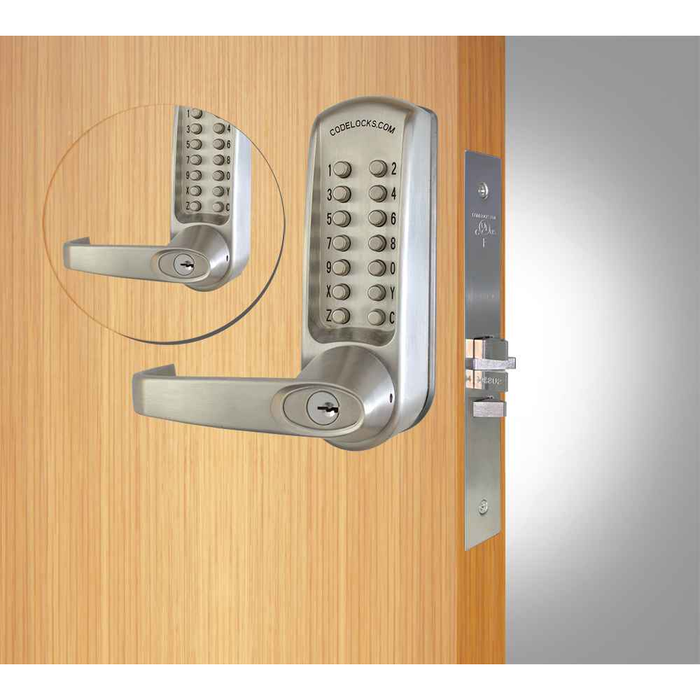
Codelocks CL650 Mortise Lock B...
IN STOCK (leaves warehouse same day if ordered before 3pm ET)
$827.01

Codelocks CL650 Mortise Lock Back-to-Back

(No reviews yet) Write a Review

Model: CL650 BS
Selected Finish is

In Stock (leaves warehouse same day if ordered before 3pm ET)

$827.01
Adding to cart… The item has been added
Free Shipping on orders over $199
We price match and offer bulk discounts! Click Add to Quote. It's quick and easy.
✨
Earn points with this purchase! You can redeem points for giftcards, iPads, XBox's and more. View Rewards
Free Keying on all locks

CL650 Mortise Lock Back to Back

The CL650 back to back is a heavy duty ANSI mortise lock.

The CL650BB is a heavy duty tubular mortise lock with a double cylinder, 3 keys and anti-panic safety function. The code in / code out (Back to Back) model provides coded acces in both directions.

The outside lever handle will retract the latch after a correct code is entered. The spring loaded latchbolt will lock automatically when the door is closed. The key retracts the latchbolt for entry without using a code. The key controls the deadbolt position. When the deadbolt is projected it denies access by code. When the deadbolt is projected the safety feature allows the inside lever handle to retract the deadbolt and the latchbolt, preventing people being accidentally lock in. The key can be used to open the doors for management functions such as security and cleaning.

Quick Code change!

The CL600 range incorporating the new Quick Code system allows on door code change in seconds. Typically most mechanical digital locks require the lock to be removed from the door or partly disassembled to change the code.

Key Features

  • Internal doors and external doors
  • Quick Code change - no need to remove lock from door
  • Mechanical Code

Technical Specs

  • Brand - Codelocks
  • Buttons - 2 x 7
  • Code Change Method - Keypad (On Door)
  • Codes - Single code storage - 8,191 non sequential combinations available
  • Door Thickness - 1 3⁄8" - 2 3⁄8" (35mm - 60mm)
  • Finish - Brushed Steel
  • Handed - Non Handed - Locks will fit doors hung on the left or right
  • Keyed Alike - Available
  • Keypad - 14 stainless steel buttons
  • Latch Type - Mortise Lock
  • Lock Material - Zinc Alloy
  • Orientation - Vertical
  • Spindle - Two part 5⁄16" (8mm) spring loaded spindle
  • Suitable For - Internal, External
  • User Types - Code

Documentation & Downloads

Manufacturer Resources

Product Specs

Product Group:
Mechanical Locks
Series:
CL600 Series
Product Subgroup:
Mortise Locks and Trim
Product Type:
Deadbolts
Subcategory:
Mechanical Locks
Commercial/Residential:
Commercial
Lock Type:
Mortise
Lock Function:
Deadbolt
Duty Level:
Heavy-Duty
Product Model:
CL650
Product Function:
Deadbolt
Product Category:
Mechanical Locks
Department:
Door Hardware

Codelocks CL650 BS – Frequently Asked Questions

1) Do I need to order a left hand or right hand Codelocks CL650?
No handing to specify. The CL650 is non handed and fits doors hung left or right, so one part number covers every opening in a building. For a property manager standardizing across a floor of doors, that means no risk of ordering the wrong hand and no need to stock both.
2) What does back-to-back mean on the Codelocks CL650, and do I need it?
Back-to-back means a keypad on both faces of the door, so a code is required to get in AND to get out. Order the Back-to-Back Option as Yes for that. Choose No and you get the coded keypad on the outside only, with lever egress from the inside. Back-to-back suits controlled interior openings, plant rooms, or pool and equipment gates where you want to restrict movement in both directions. For any door in an egress path, the single sided version is the one you want.
3) Can someone get locked in behind a Codelocks CL650 when the deadbolt is thrown?
No. The CL650 has an anti-panic safety function: with the deadbolt projected, the inside lever retracts both the deadbolt and the latchbolt in one motion, so a person inside always gets out. Projecting the deadbolt denies entry by code from outside, which is how you secure a room overnight without trapping anyone who is still in it. This is the detail that matters most on the back-to-back version.
4) How do you change the code on a Codelocks CL600 lock without taking it off the door?
The CL600 range uses the Quick Code system, changed at the keypad on the door in seconds. Most mechanical digital locks have to be removed or partly disassembled to change a code, which is why code changes get skipped in the field. The CL650 stores a single code at a time, chosen from 8,191 non sequential combinations on a 14 button stainless steel keypad arranged 2 x 7. For a property manager doing turnover between tenants or a contractor rotating site access, the code changes without a service call.
5) Does the Codelocks CL650 take a key as well as a code?
Yes, it is a double cylinder lock supplied with 3 keys. The key retracts the latchbolt for entry without a code, and the key alone controls the deadbolt position. That split matters operationally: staff and residents use the code for daily access, while management keeps key override for security rounds, cleaning, or an inspection. Keyed alike is available if you want one key across multiple CL650 doors.
6) What is a keyed alternative to the Codelocks CL650 for a door where a mechanical code entry is not wanted?
The CL650 is a heavy duty mortise deadbolt operated by a mechanical code with a key override. If the opening needs key-only control instead of code entry, the Corbin Russwin DL3011 is a Grade 1 cylindrical deadlock with a deadbolt function and a 1-3/4 inch to 2-1/4 inch door thickness range, and the Corbin Russwin DL3211 is a Grade 1 cylindrical deadlock with a deadbolt function for 1-3/4 inch doors. Both drop the keypad entirely, so access is by key alone and there is no code to distribute or change.
7) What is the difference between the Codelocks CL650 and an electronic deadbolt like the Delaney KP400 or Dormakaba Saffire LX-D?
The CL650 is a mechanical code lock: 14 stainless steel buttons in a 2 x 7 layout, a single stored code with 8,191 non sequential combinations, and code changes made on the door through the keypad with no battery or wiring involved. The Delaney KP400 is a Grade 2 electronic deadbolt with a programmable remote, and the Dormakaba Saffire LX-D is an RFID electronic deadbolt with BLE and electronic lock override. Those two credential the user electronically and add remote or card-based management; the CL650 keeps everything at the door.
8) Can a standard double cylinder deadbolt replace the Codelocks CL650 on an exit door?
Not without changing how the door behaves. The CL650 back to back has a double cylinder plus an anti-panic safety function: with the deadbolt projected, the inside lever retracts both the deadbolt and the latchbolt in one motion so nobody is accidentally locked in. Conventional double cylinder deadbolts such as the Callan 210S, the Delaney LU Series 320601, the Dexter DB2000 double cylinder and the Design Hardware D1 Series are all double cylinder function, which means the inside is released by key. For an egress door that needs thumbturn release without a key, the Arrow E60 is a Grade 2 exit deadlock with a blank plate by thumbturn function for 1-3/8 inch to 1-3/4 inch doors.
9) Should I use a mechanical code lock like the Codelocks CL650 or an electronic keypad deadbolt?
The CL650 is mechanical: no batteries, no wiring, no audit trail, no user database. It holds one code at a time and you change it at the keypad. That is the right call for gates, storage, plant rooms, and remote openings where nobody is going to change a battery. If you need multiple user codes, remote programming, or credential based access, look at an electronic option instead, such as the Delaney KP400 Grade 2 electronic deadbolt with programmable remote, or the Dormakaba Saffire LX-D RFID electronic deadbolt for card based multihousing use.
10) What is the difference between the Codelocks CL650 and a plain keyed deadbolt?
The CL650 is a self latching mortise lockset with levers, not a standalone deadbolt. The spring loaded latchbolt locks automatically when the door closes, the outside lever retracts it after a correct code, and the deadbolt is a separate key controlled function on top of that. A conventional deadbolt like the Arrow DBX61 Grade 2 single cylinder or the Design Hardware D1 Series Grade 1 double cylinder does one job: throw a bolt with a key or turn, and it is added alongside a separate latching lockset. If the door already has a working lever lock and you only need to add security, a deadbolt is the smaller job. If you are replacing the whole lockset and want code access, the CL650 is the one part.
11) Is the Codelocks CL650 a mortise lock that needs a mortise pocket in the door?
It is a tubular mortise lock, so the case goes into a bored pocket in the door edge rather than the deep rectangular mortise a full ANSI mortise case needs. Codelocks publishes an installation template for the CL620, CL625 and CL650 that gives the prep. The keypad mounts vertically on the face of the door, which is what dictates how much clear face area you need above and below the lever.
12) What is a simpler deadbolt to specify when the Codelocks CL650 keypad is more than the opening needs?
The CL650 carries a keypad, a double cylinder and a code change system for openings where access has to be shared without issuing keys. Where a plain thumbturn will do, the Dexter DB1000 single cylinder is a Grade 1 cylinder by thumbturn deadbolt for 1-3/8 inch to 1-7/8 inch doors, the Deltana CL200LM is a Grade 1 single cylinder deadbolt, and the Delaney LM Series 301702 is a Grade 1 single cylinder less core deadbolt in dull chrome US26D. At Grade 2, the Cal-Royal CB160 is a single cylinder deadbolt with a tamper-resistant cylinder guard.
13) Does the Codelocks CL650 need a mortise lock strike like the Arrow 460?
The CL650 is a mortise lock with a spring loaded latchbolt that locks automatically when the door closes, plus a separate key-controlled deadbolt, so the frame needs a strike that accepts both bolts. The Arrow 460 mortise lock strike is prepared for latchbolt and deadbolt functions with a straight lip and is listed for 1-3/4 inch doors. It is a frame component only, not a substitute for the lock itself.
14) For a facility standardizing on interchangeable core, what deadbolt works alongside the Codelocks CL650?
The CL650 uses a double cylinder supplied with 3 keys and is available keyed alike, which covers openings kept on one key. Where an SFIC or IC program is the standard, the Arrow E61 26D IC is a Grade 2 single cylinder deadlock with SFIC prep less core for 1-3/8 inch to 1-3/4 inch doors, the Deltana CL200LAIC is a Grade 2 single deadbolt with an interchangeable core and a 2-3/4 inch backset, and the Delaney LM Series 301702 is a Grade 1 single cylinder less core deadbolt. Those three take the facility core; the CL650 comes with its own cylinder and keys.
15) What deadbolt suits an exterior gate or coastal door better than a standard commercial deadbolt?
The Codelocks CL650 is rated for internal and external doors and comes in Brushed Steel and a Black Marine Grade finish, which is the one specified for salt air and weather exposure. Comparable commercial deadbolts such as the Hager 3215 and the Dexter DB2000 single cylinder are cylinder by thumbturn locks for 1-3/8 inch to 1-3/4 inch doors and are trimmed for interior-style openings, and the Kaba Ilco 4500 Series is a heavy duty professional deadbolt. For an exposed opening the marine grade finish is the differentiator.
16) Is a classroom function deadbolt the same thing as the Codelocks CL650?
No. The Falcon D111 is a Grade 1 classroom deadbolt with an adjustable backset and cylinder by thumbturn function, the Falcon D211 is the Grade 2 version, and the Hager 3118 is a Grade 1 classroom deadbolt with a Schlage C keyway and a 6-pin cylinder for 1-3/8 inch to 1-3/4 inch doors. All three are keyed locks where a teacher or staff member secures the room with a key. The CL650 controls the same door by a mechanical code entered on a 14-button keypad, with the key used only to override the latch and to set the deadbolt position for management functions such as security and cleaning.
17) Does the Codelocks CL650 need to be ordered handed like some mortise locks?
No. The CL650 is non handed and fits doors hung left or right, so one part number covers both swings across a building. Among keyed alternatives, the Cal-Royal ED500 is a Grade 3 single cylinder deadbolt with an adjustable backset for 1-3/8 inch to 1-3/4 inch doors and the Brinks Raleigh E2401 is a single cylinder deadbolt with a 4 way adjustable backset, both of which cover backset variation the same way rather than requiring a handing call-out.
18) What is the difference between the Codelocks CL650 and an electric deadbolt like the DynaLock 1300?
The DynaLock 1300 Series is a heavy duty mortise electric deadbolt, so it is released by an access control system and depends on power and wiring at the frame. The CL650 is a mechanical code lock: the outside lever retracts the latch after a correct code, the latchbolt locks automatically on close, and the code is changed on the door in seconds through the keypad with no access control head end behind it.
19) What is a heavier deadbolt than the Codelocks CL650 for a high traffic entry?
The CL650 is a heavy duty commercial mortise lock in zinc alloy. Where the spec calls for a higher duty keyed deadbolt, the Design Hardware D1 Series is an extra heavy duty Grade 1 double cylinder deadbolt for 1-3/4 inch doors, and the Cal-Royal CRB800 is a Grade 1 heavy duty single cylinder deadbolt. The Accentra D111 is a Grade 1 single cylinder deadbolt with a 2-3/8 inch backset covering 1-3/8 inch to 1-3/4 inch doors.
20) Can I key multiple Codelocks CL650 locks to the same key across a building?
Keyed alike is available on the CL650, so a set of doors can share one management key while each door carries its own code. Practically that gives a maintenance tech a single key for override across the openings, and lets you change the code on any one door at the keypad without touching the keying.
21) What finishes does the Codelocks CL650 come in?
Two: Brushed Steel and Black, Marine Grade. Both are offered with or without the back-to-back keypad. Brushed Steel is the general purpose interior and exterior choice; the marine grade black is the one to specify for salt air, pool decks, and coastal exposure where a standard finish breaks down first.
How fast can I get the Codelocks CL650 BS delivered?
Most orders ship the same day from our distribution partners, with quick delivery throughout the continental U.S. Need it urgently? Contact Us for expedited shipping options.
Can I return it if it doesn’t work for me?
Yes—ZenSupply offers a hassle-free return policy. If the product isn’t the right fit, reach out to our support team for a return authorization or setup a return by following our return instructions.
Does the Codelocks CL650 BS come with a warranty?
Absolutely. The Codelocks CL650 BS is backed by a manufacturer’s warranty. For full warranty terms, check the product documentation or Contact Us.
How do I get technical support or installation help for the Codelocks CL650 BS?
You can call, text, or email our expert support team for fast answers. We’re here to help with product selection, installation tips, and troubleshooting. Contact Us
Why buy the Codelocks CL650 BS from ZenSupply?
ZenSupply makes it easy to get the commercial door hardware you need—fast shipping, expert support, and rewards on every order. Our team is always ready to help you choose the right product for your project.