


Concealed Door Closers: Commercial Buying Guide for Specifiers
Products in this guide
At a Glance
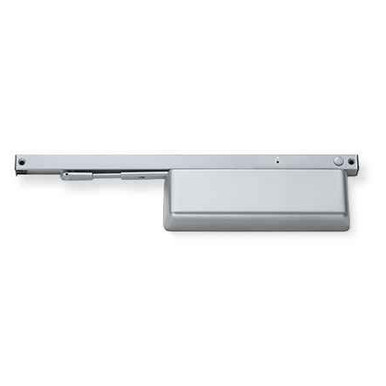
- LCN 2030-Series (overhead concealed): architectural-grade concealed closer for aluminum and hollow metal frames with 1-3/4" head rail — the default when the elevation can't show a surface closer body.
- Norton Rixson 7900 Series (overhead concealed): architectural-grade concealed closer with multi-point hold-open; strong fit for monumental entrances and glazed storefront.
- dormakaba ITS9625 (overhead concealed) / BTS80 (floor): European-engineered concealed closers for center-hung and offset-hung aluminum and all-glass doors.
- Norton Rixson 27 / Q27 floor closers: heavy-duty offset-hung floor closers for high-traffic entries where a flush walking surface is required.
- All concealed closers covered meet A156.4 Grade 1 — 2,000,000 cycles minimum when specified in Grade 1 configuration.
What is a concealed door closer and where is it used?
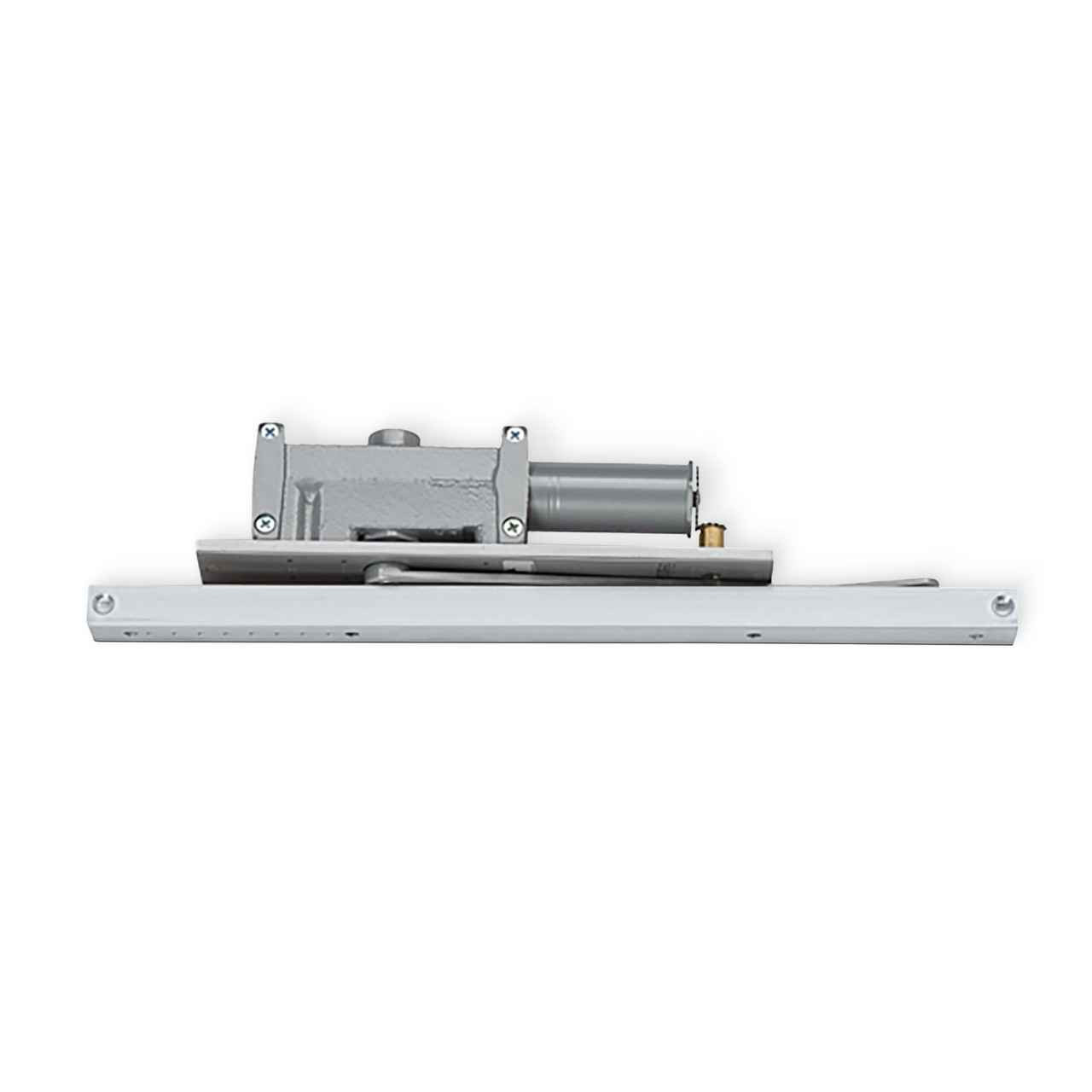
A concealed door closer hides the hydraulic body inside the frame head, the door leaf, or the floor so nothing projects into the sightline when the door is closed. Specifiers reach for them when the elevation can't tolerate a visible closer body: monumental entrances, all-glass storefront, executive suites, high-end hospitality, and tenant lobbies.
Three mounting families cover almost every application: overhead concealed (closer body sits in the frame head), floor-mounted (body sits in a cement case below the finish floor), and concealed-in-door cam-action units. Each has its own frame-prep demand, and the choice is usually locked in at the frame-schedule stage — not at hardware submittal. Browse the full lineup of overhead concealed door closers to see what's commonly stocked.
What is the difference between overhead concealed and floor-mounted concealed closers?
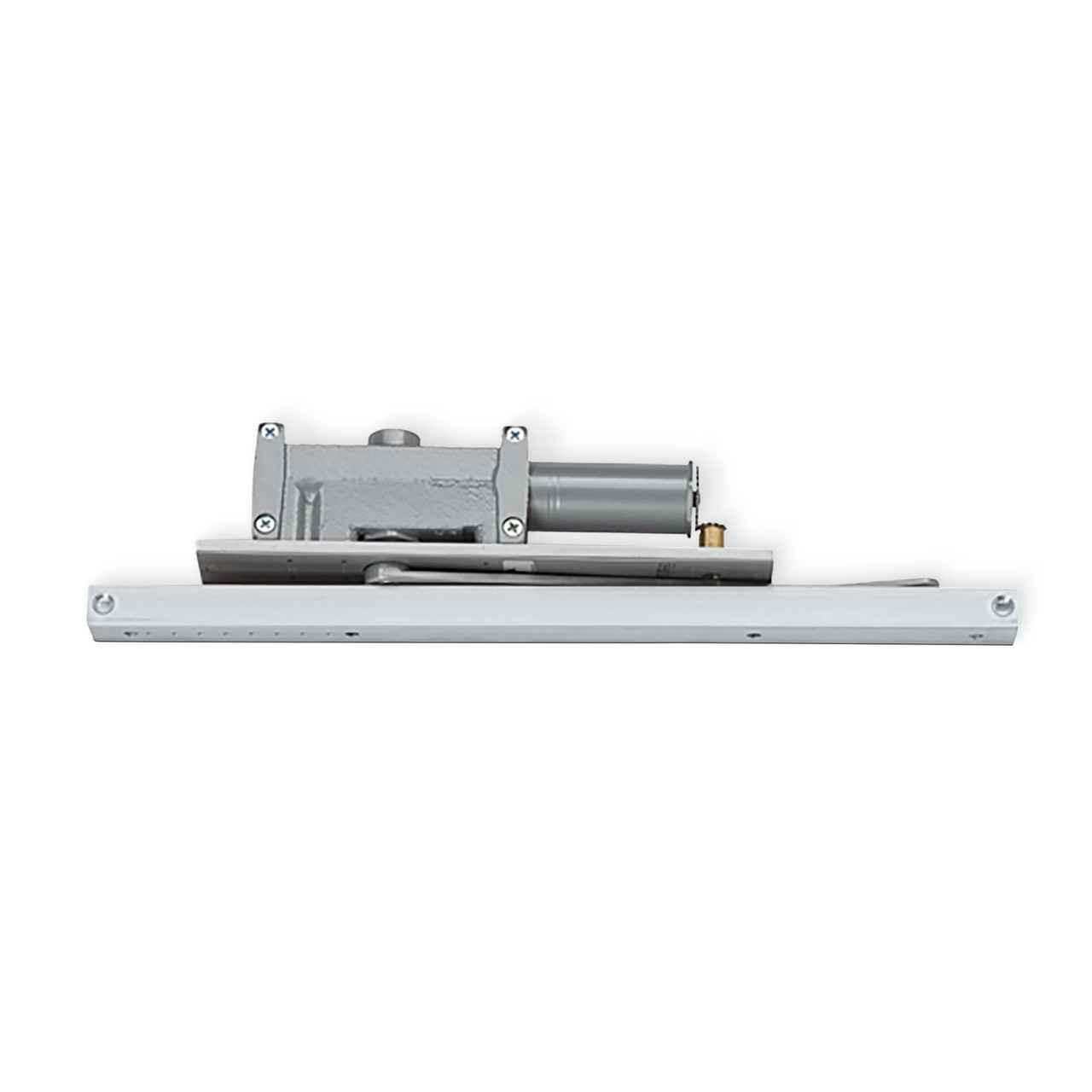
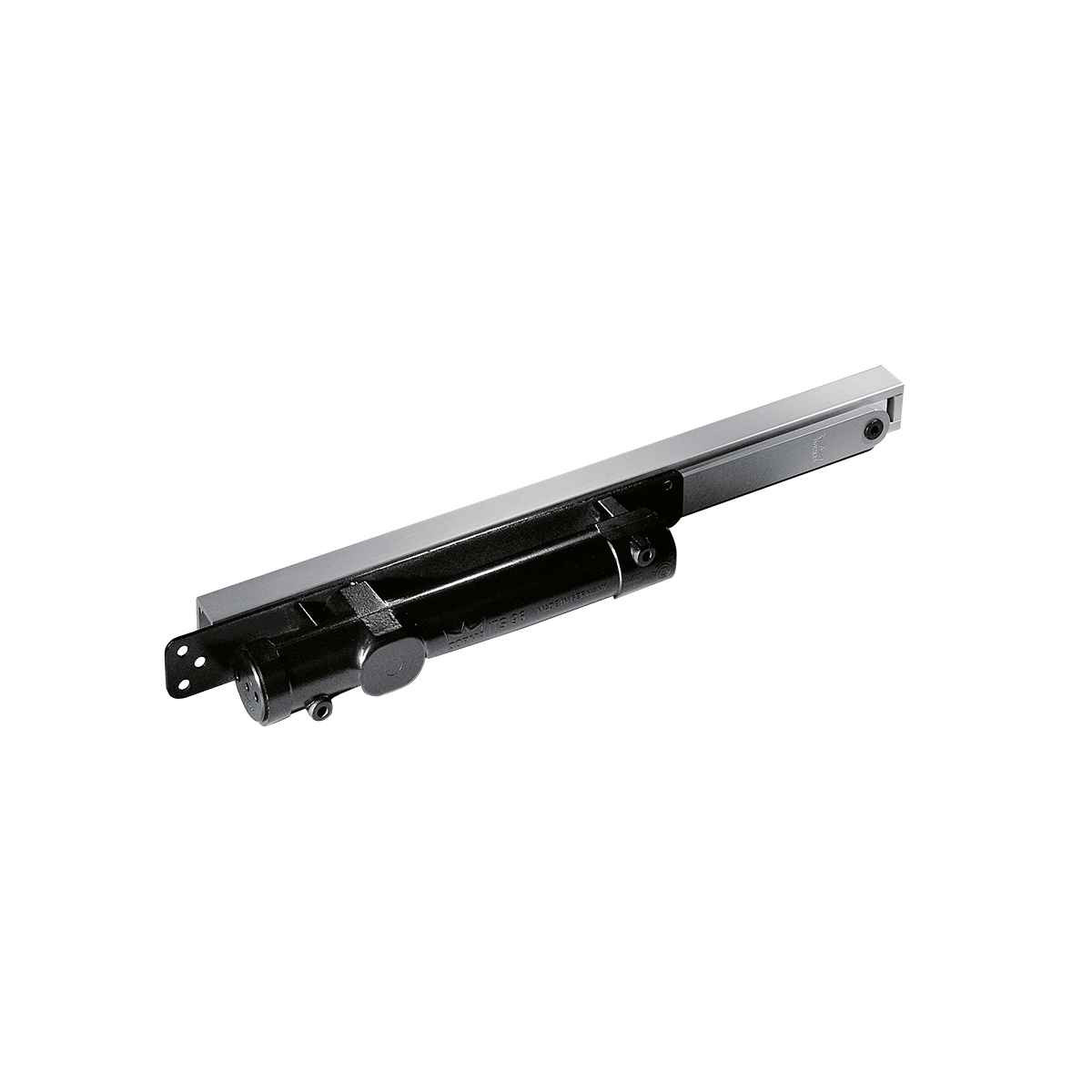
Overhead concealed closers mount in the transom or head frame. They require a frame with a hollow head deep enough to accept the cylinder — typically 4" minimum head depth for architectural-grade units. The arm connects to a top pivot or spindle on the door. Service access is through the frame head, so a drop ceiling or scaffold is enough; you don't disturb the floor.
Floor-mounted closers (floor closers) sit in a cement case cast into the slab. They carry the door weight as well as closing it, which is why they're specified for heavy monumental doors, all-glass pivot doors, and high-cycle entries that would chew through pivots. Downside: service means pulling the door and the cover plate, and the cement case has to be set during the slab pour or chased in afterward.
Concealed cam-action closers (cam action closers) hide inside the top rail of the door leaf itself, with a slide track in the frame head. They're a good fit for narrow-stile aluminum and interior wood doors where neither a head cylinder nor a floor case is practical.
Top concealed closer models: LCN 2030/3030, Norton Rixson 7900, dormakaba RTS/BTS
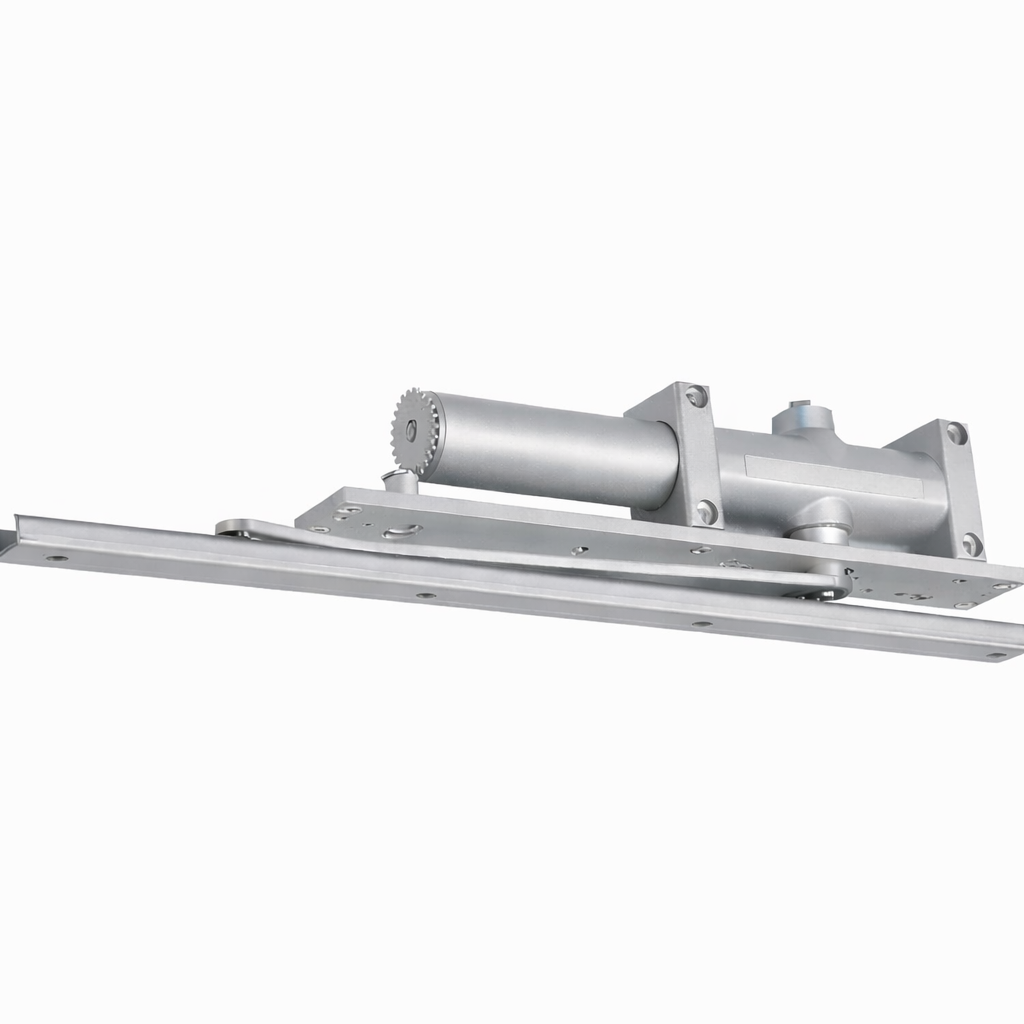
The specification stack for concealed closers is narrower than for surface closers — a handful of architectural-grade series dominate.
LCN overhead concealed: the LCN 2210/2211 Series is the current Grade 1 high-security overhead concealed line, with a 180° swing and enhanced backcheck for institutional and corrections work. The 2030 and 3030 families run as concealed-in-frame closers across common frame sizes, with hold-open and electromechanical variants available (LCN 2314ME Sentronic for fire/life-safety hold-open release). For concealed-in-door applications on interior wood or hollow metal, the LCN 2014 and sister 2015/2016 variants cover sizes 1 through 6.

Norton Rixson overhead concealed: the Norton Rixson 7900 Series is the architectural flagship — multi-point hold-open, security features on the 7970 variant, and sized for monumental entrances. The Rixson 91 Series handles offset-hung architectural doors up to 250 lb, and the Rixson 73 Series covers center-hung double-acting doors.
dormakaba overhead concealed and floor: the dormakaba ITS9625 is the overhead concealed closer, Size 2-5, for aluminum and all-glass doors, paired with top pivots and patch fittings. The dormakaba BTS80 is the matching floor closer for center-hung and offset-hung applications, with a hold-open variant (BTS80C) and a fire-rated variant (BTS75VF). The dormakaba ITS9613 is the concealed-in-door cam closer specified where neither a head cylinder nor a floor case fits.

Norton Rixson floor closers: the Rixson 27 Series and its quick-install cousin Rixson Q27 are the heavy-duty 3/4" offset-hung floor closers that dominate the floor-closer spec. For lead-lined X-ray doors and vault doors, the Rixson L27 handles up to 1,500 lb.
Are concealed door closers ADA compliant?
Yes — concealed closers meet ADA when the spring is sized correctly and the sweep speed is adjusted on install. ADA 2010 §404.2.9 limits interior door opening force to 5 lbf; fire doors are exempt (they must close and latch), and exterior doors have no ADA opening-force maximum. All architectural-grade concealed closers covered above are adjustable through at least sizes 1-6 and can be dialed to meet the 5 lbf interior requirement on reasonably sized doors.
Where a concealed closer struggles with ADA is the mechanical compromise of pulling a heavy, weatherstripped exterior door with a size-3 spring. Spec a delayed action closer when assisted egress is needed, or move to a low-energy automatic operator for true ADA assistance.
Backcheck is standard on architectural-grade concealed closers and should be tuned at install to engage around 70° to protect the frame and adjacent walls.
Can concealed door closers be used on fire-rated doors?
Yes — provided the specific closer is labeled for use in a fire-rated door assembly tested to UL 10C, and the installation follows NFPA 80. The dormakaba BTS75VF is the common fire-rated floor closer; the Norton Rixson 73ER adds emergency-release for fire assemblies with double-acting doors; and LCN's 2314ME Sentronic integrates concealed closing with fire-alarm-released hold-open.

Two NFPA 80 rules bite hardest on concealed assemblies: mechanical hold-open is prohibited on fire-rated doors (electromagnetic hold-open released by the fire alarm is permitted), and the closer must self-close and latch from any open position. Shop fire and life safety closers for the labeled lineup.
Can you add hold-open or electromagnetic hold to a concealed closer?
On non-rated openings, mechanical hold-open is available on most concealed closer families — the BTS80C, Rixson floor closers with hold-open, and LCN hold-open variants all handle it in the mechanism. For fire-rated openings, specify an electromechanical closer-holder: LCN 2314ME concealed, LCN 4040SE/4040SEH surface, or a separate magnetic door holder tied to the fire alarm.
For full power-assist ADA compliance, step up to a low-energy automatic operator. The LCN 6440 Compact and LCN 9540 Senior Swing handle ADA-compliant push-plate operation and preserve the concealed appearance on the closed door.

Installation, templating, and frame prep pitfalls
Concealed closers live or die on frame prep. Three traps show up repeatedly in field submittals:
Head depth and reinforcement. Overhead concealed bodies need a minimum head depth (typically 4" clear) and factory reinforcement at the hinge jamb to carry the arm load. Hollow metal frames must be ordered with the correct closer prep from the frame vendor — field-cutting a frame is a non-starter for architectural grade.
Floor closer cement case tolerance. The cement case must be set level and square to the door opening before the pour. Out-of-square cases force the spindle off center and the door hangs crooked for the life of the opening. Verify dimensions against the frame and door width at rough-in, not finish.
Deep reveal and ceiling conditions. Where the frame reveal exceeds standard, step up to a deep-reveal variant (Rixson 127 or 427 for floor closers, LCN 2211 security track for overhead). Overhead stops may be needed as a backup; see overhead stops and holders.
Spec'ing concealed closers for a project? Browse our overhead concealed door closer inventory — architectural-grade LCN, Norton Rixson, and dormakaba in stock with submittal support.
How LCN, Norton Rixson, and dormakaba compare on concealed closers

LCN (Allegion) owns the North American institutional and healthcare spec. The 2030/3030 overhead concealed and 2010 series are the default on hollow metal frames in schools, hospitals, and government — mostly because LCN's cycle life and parts availability are predictable, and the 10-year warranty on the architectural grade matches what facilities teams want to see.
Norton Rixson (Assa Abloy) wins the monumental-entrance and architectural-glass work. The 7900 overhead concealed and the 27-series floor closers are the specification choice where the entry has to look invisible and still handle lobby-traffic cycles. Rixson's floor-closer heritage carries the brand in high-end commercial.
dormakaba is the European-engineering choice, and the natural pick on all-glass storefront, patch-fitting entries, and projects already using dormakaba access control. The ITS9625 overhead and BTS80 floor closers integrate cleanly with top pivots and patch fittings sized for 12 mm glass. If the glass package is dormakaba, the closers almost always are too.
Choose LCN when:
- Project is institutional (healthcare, education, government) and the facility team wants parts commonality across openings
- Frames are hollow metal with standard concealed-closer prep
- Fire/life-safety hold-open release is in scope (2314ME Sentronic)
- You need deep catalog of hold-open, delayed-action, and electromechanical variants
Choose Norton Rixson when:
- Opening is a monumental entrance, lobby, or architectural-glass door
- Floor closer is the only option (heavy pivot door, flush walking surface required)
- Deep reveal, lead-lined, or high-cycle entry needs a heavy-duty 27/127/L27 body
- Center-hung double-acting is in the schedule (73 Series)
Choose dormakaba when:
- Door is all-glass, patch-fitting, or narrow-stile aluminum
- Project is already using dormakaba access control or sliding systems
- Concealed-in-door cam action (ITS9613) is the only mechanical fit
- Fire-rated floor closer is needed (BTS75VF)
| Brand / Series | Mount | BHMA Grade / Cycle | Best For | List Price Tier |
|---|---|---|---|---|
| LCN 2210/2211 | Overhead concealed | Grade 1 per A156.4 — 2,000,000 cycles minimum | Institutional, high-security, 180° swing | Mid |
| Norton Rixson 7900 | Overhead concealed | Grade 1 per A156.4 — 2,000,000 cycles minimum | Monumental entrances, architectural glass | High |
| dormakaba ITS9625 | Overhead concealed | Grade 1 per A156.4 — 2,000,000 cycles minimum | All-glass and aluminum storefront | High |
| Norton Rixson 27 / Q27 | Floor (offset-hung) | Grade 1 per A156.4 — 2,000,000 cycles minimum | Heavy entry doors, flush floor requirement | High |
| dormakaba BTS80 | Floor (center/offset) | Grade 1 per A156.4 — 2,000,000 cycles minimum | All-glass pivot doors, patch-fitting entries | High |
| dormakaba ITS9613 | Concealed-in-door cam | Grade 1 per A156.4 — 2,000,000 cycles minimum | Narrow-stile, interior wood, no head/floor pocket | Mid |
How to spec and order concealed closers for your project
Lock the mounting family in at the frame schedule — not at hardware submittal. Call out: closer model and size, mount (overhead concealed, floor, concealed-in-door), door handing and swing degrees, finish, hold-open or non-hold-open, fire rating if applicable, and any electromechanical function. For floor closers, confirm cement case model and whether the GC is setting it or the hardware installer is. For overhead concealed, confirm frame head depth and factory reinforcement with the frame supplier before order.
Expect architectural concealed closers to carry a meaningful premium over surface closers like the LCN 4040XP — you're paying for the sightline and the reinforced frame work. For non-architectural openings where the closer can show, step down to heavy duty surface closers and save the budget for the openings where concealment is a design requirement.
Need help speccing concealed closers for a project? Shop LCN, Norton Rixson, and dormakaba architectural concealed closers at ZenSupply's overhead concealed door closer inventory — submittal support, finish verification, and volume pricing on request.