


Wiremold Surface Raceway: Series, Sizing, and Fittings Guide
Posted by ZenSupply Electrical Team on Aug 3rd 2026
Wiremold Surface Raceway: Series, Sizing, and Fittings Guide
At a Glance
- Wiremold (Legrand) is the default spec for surface raceway on commercial retrofits — steel and nonmetallic, with the broadest fitting family in the category.
- Steel series (500, 700, 2400, 4000, 6000) are listed to UL 5 and governed by NEC Article 386. They can serve as an equipment grounding path when listed and properly bonded.
- Nonmetallic series (400, 800, 2300, 5400) are listed to UL 5A under NEC Article 388 — lighter and faster to cut, but you pull a separate EGC.
- Two-compartment raceway (4000, 6000) keeps power and Class 2 data in separate channels, which is what satisfies NEC 725.136 separation. Single-channel raceway does not.
- Fill is governed by the listing, not a blanket percentage. The 40% figure everyone quotes is a Chapter 9 conduit number — it does not apply to surface raceway.
What is Wiremold and when should you spec surface raceway?
Wiremold is a Legrand brand of surface-mounted steel and nonmetallic raceway used to route power, data, and low-voltage cabling across finished walls, floors, and ceilings without opening up existing construction. It is the standard answer for tenant improvements, historic buildings, exposed masonry, and any retrofit where fishing wire through a wall is not realistic.
Spec surface raceway when the substrate is concrete, brick, or CMU; when the ceiling is inaccessible; when the tenant relocates devices frequently; or when the AHJ prefers exposed, inspectable wiring methods. Browse the full range in raceway & cord covers, or step up a level to conduit & raceway when the run transitions to pipe.
NEC Article 386 covers surface metal raceway; Article 388 covers surface nonmetallic raceway. Both are dry-location methods unless the specific listing says otherwise, and neither belongs anywhere subject to severe physical damage.
Which Wiremold series should you use?
500 and 700 Series (steel, single-channel). The workhorses for branch circuits and single-device drops. The Wiremold 700 Series steel raceway is the deepest-stocked base in the line, and it carries the largest fitting family of any single-channel series — connection covers, mounting straps, elbows, combination connectors, and fixture boxes all field-fit without a custom part.
2400 Series (steel, two-piece). Base mounts first, conductors drop in, cover snaps on. On long runs that is materially faster than pulling through a single-channel raceway.
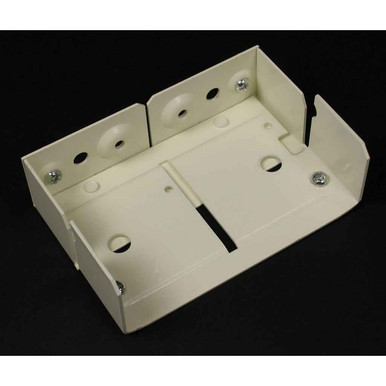
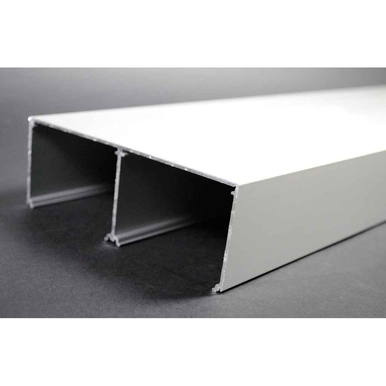
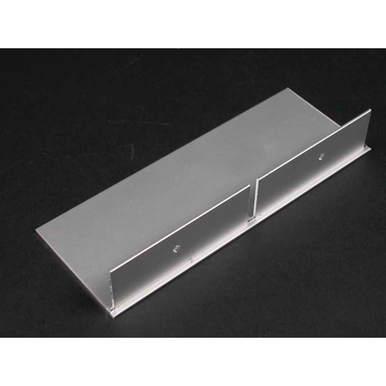
4000 Series (steel, two-compartment). The commercial floor-to-desk and wall power/data standard. Dedicated power and communications channels in one raceway. The compartments are not created by the base and cover alone — you need the G4000D divider fitting to actually segregate them, and the G4000WC wire clip to dress conductors inside the base.
6000 Series (steel, two-compartment, high capacity). Same architecture as the 4000 with more room. Divider segregation works the same way, via the G6000DA divider fitting.
Nonmetallic (400, 800, 2300, 5400). PVC, UL 5A, Article 388. The 400 Series nonmetallic raceway and 800 Series base and cover cover most cost-driven retrofits; the 2300 Series base and cover is the low-profile option. If the run is going to transition to buried or concealed pipe, coordinate with PVC conduit & fittings.
Need surface raceway now? Browse our raceway & cord covers inventory — deep stock on 700 Series steel base and the nonmetallic 400/800/2300 lines, with fittings that ship alongside the base instead of two weeks behind it.
How do I size and calculate fill for Wiremold raceway?
This is where most surface-raceway takeoffs go wrong. Fill for surface metal raceway is governed by NEC 386.22, and for nonmetallic by NEC 388.22. Neither one sets a blanket percentage. The governing limit is the number of conductors the raceway is designed and listed for — you read that off the manufacturer's fill table for the specific series, not off a percentage.
The 40% figure that gets quoted in raceway conversations comes from Chapter 9 and applies to conduit. Applying it to surface raceway is the single most common error in this category.
There is one percentage that does apply, and it matters for exactly the series most commercial jobs use. Under the NEC 386.22 exception, surface metal raceway with an interior cross-sectional area greater than 4 square inches may be filled to 20% of that area — and the ampacity adjustment factors of NEC 310.15 do not apply to those raceways for up to 30 current-carrying conductors. So the reflexive "derate above three current-carrying conductors" is wrong for the large two-compartment series. Check whether your raceway clears the 4-square-inch threshold before you derate anything.
Two more rules worth holding onto. Multi-compartment raceway is treated as separate raceways for fill — do not sum the channels. And support spacing comes from the listing and the manufacturer's instructions per NEC 386.30 and 388.30; the NEC itself does not hand you an interval, so do not quote one as a code requirement. Fasten with conduit hangers & straps appropriate to the substrate.
Can you install receptacles and data jacks inside Wiremold?
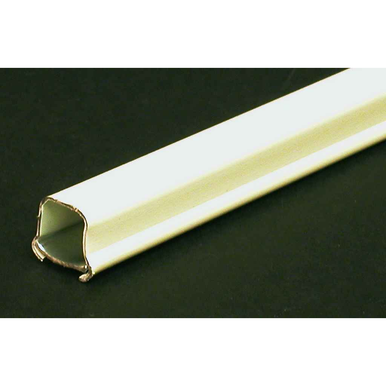
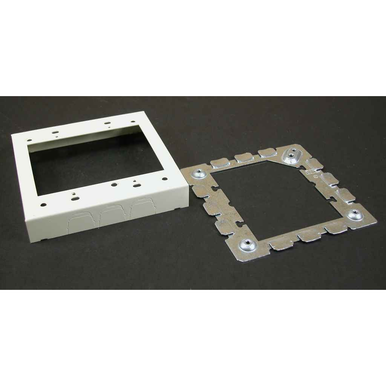
Yes, and it is most of the reason to spec it. Wiremold device boxes, in-line boxes, and dual-service fittings accept standard NEMA receptacles, decorator devices, and modular data jacks. The single-gang steel device box is the typical single-device adapter, and the 500/700 Series solid-base fixture box handles fixture and surface-mount drops. Faceplates finish the opening — the 5507 Series duplex faceplate for a standard duplex, or the blank and rectangular variants where the opening is spare or carries a jack.
Standard 15A/20A duplex devices drop straight in; pull them from receptacles & outlets. Where the raceway lands on a larger enclosure instead of a device box, coordinate with outlet & switch boxes.
Keep Class 1 power and Class 2 low-voltage in separate compartments per NEC 725.136. Two-compartment raceway makes that automatic. Single-channel raceway does not, and a divider fitting is not optional if you are sharing a run.
What fittings and accessories do I need with Wiremold?
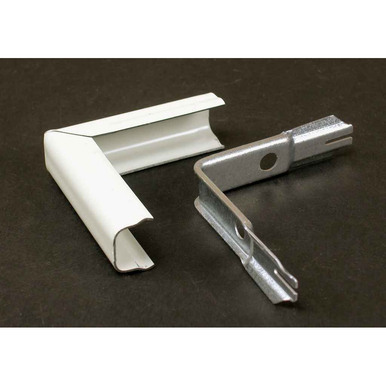
Order base and cover in linear feet, then count fittings against the actual route — entrance ends, couplings, internal elbows for inside corners, external elbows for outside corners, flat elbows for same-plane 90s, tees for branches, and blank ends. Miss one fitting and the run stops at the wall.
For a 700 Series run, the recurring parts are the 700 Series connection cover at every joint, the 700 Series mounting strap at each support point, and a combination connector wherever the raceway meets a box. Where the transition is to armored cable, the 5790B armored cable connector is the 500/700 fitting for it.
On two-compartment runs, budget the divider strip and clips as line items. The base and cover do not segregate the channels by themselves — that is what the divider fittings are for, and it is the most commonly forgotten part on a 4000 or 6000 takeoff.
How do the Wiremold series compare?
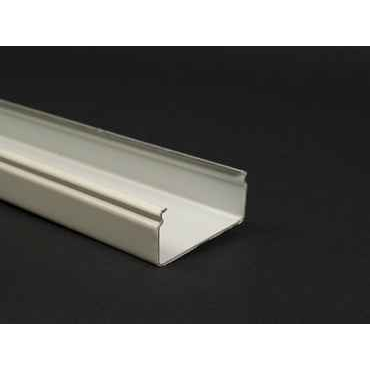
| Series | Standard / Article | Construction | Best For | List Price Tier |
|---|---|---|---|---|
| Wiremold 700 Series | UL 5 / Art. 386 | Single-channel steel | Branch circuits and single-device drops on masonry; deepest fitting family | Value |
| Wiremold 500 Series | UL 5 / Art. 386 | Low-profile single-channel steel | Tight, low-profile runs where 700 is oversized | Value |
| Wiremold 4000 Series | UL 5 / Art. 386 | Two-compartment steel | Commercial power/data in one run; workstation feeds | High |
| Wiremold 6000 Series | UL 5 / Art. 386 | Two-compartment steel, high capacity | Heavy commercial and industrial where 4000 fills up | High |
| Wiremold 400 Series | UL 5A / Art. 388 | Nonmetallic PVC | Cost-driven retrofits in dry locations; separate EGC required | Value |
| Wiremold 2300 Series | UL 5A / Art. 388 | Low-profile nonmetallic | Low-profile nonmetallic runs on finished walls | Value |
Panduit and Hubbell both publish competing surface-raceway lines, and you will see them called out on spec sheets — Panduit's from the structured-cabling side, Hubbell's alongside its wiring devices. Wiremold is the line we carry, and it is the one with the fitting depth to finish a run without substitutions.
What else should you coordinate on a raceway job?
Surface raceway rarely lands alone. Floor-fed workstations pull in poke-thru and floor-box assemblies; wall-fed runs terminate into device boxes and faceplates. If the run is carrying data as well as power, coordinate the raceway compartment layout with the structured-cabling design before you order, because retrofitting a divider into an installed run means pulling the cover off the whole thing. See cable support systems for the supports and hangers side of the same job.
Ready to spec and order? Shop Wiremold surface raceway at ZenSupply — steel and nonmetallic series, matching fittings, and volume quotes for commercial projects.