


Commercial Locks Buying Guide: Mortise, Cylindrical & Electrified Compared
Products in this guide
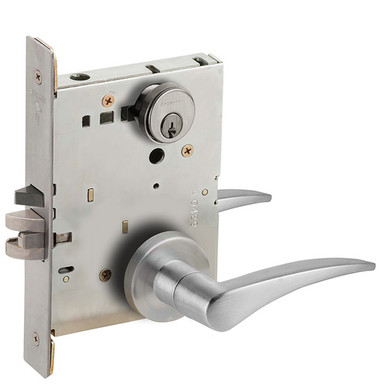
At a Glance
- Schlage L9082 mortise — Grade 1 per A156.13, the spec default for institutional and high-traffic openings where durability and function flexibility matter.
- Schlage ND Series cylindrical lever — Grade 1 per A156.2, the workhorse for offices, classrooms, and tenant suites; faster to install than mortise.
- Sargent 8200-series mortise — Grade 1 mortise alternative to the L9050, strong in healthcare and higher-ed specs.
- BEST 45H mortise — Grade 1 mortise built around the 7-pin SFIC platform; the right call when you're keying an entire facility on interchangeable cores.
- Adams Rite 7400 series electric strikes — pair with mechanical locks to add access control without swapping the lockset.
Mortise vs. cylindrical vs. electrified: which commercial lock fits your opening?

Three questions decide the lock type: traffic volume, function complexity, and whether the opening needs electronic control.
Mortise locks install into a pocket cut into the door edge — standard prep is 6" H × 4" D × 1" W. The lock body houses the latch, deadbolt, and multiple function cams in one chassis, so a single body can be ordered as office, classroom, storeroom, dormitory, or hotel function. Grade 1 mortise per A156.13 is tested to 1,000,000 cycles minimum. Spec mortise for main entries, classrooms, patient rooms, and any opening where you need a deadbolt and latch operating from one trim.
Cylindrical locks install through two round bores (standard 2-1/8" cross bore, 1" edge bore). Grade 1 cylindrical per A156.2 is 800,000 cycles minimum. Faster to install, cheaper per opening, and easier to service — the right answer for the bulk of interior commercial openings. See the full commercial mortise locks category when the opening calls for mortise, and mechanical locks for the broader cylindrical selection.
Electrified locks are either mortise or cylindrical bodies with a solenoid that locks or unlocks the outside trim on command. Spec electrified when the opening needs card, fob, or REX control AND you want to keep mechanical key override — more on that below.
Which cylindrical lever lock should I spec, and what trim do I need?
Cylindrical lever is the volume category. Lever operation is ADA 404.2.7 compliant out of the box — no tight grasping, pinching, or twisting. Knobs are not.
The Schlage ND-Series is the Grade 1 benchmark. Schlage ND80PD (storeroom function, always locked outside, always free egress) is the single most-specified function in commercial new construction. ND53PD is the entrance/office function, ND70PD is classroom, and ND82PD is institutional (keyed both sides). All are tested to the A156.2 Grade 1 threshold of 800,000 cycles minimum.
The Schlage ALX-Series (the current replacement for the discontinued AL-Series) is the Grade 2 value step — 400,000-cycle minimum per A156.2. Use ALX for lower-traffic interior openings where budget drives the spec. The BEST 9K Series is the direct Grade 1 cross for ND, with the BEST SFIC core as the differentiator.
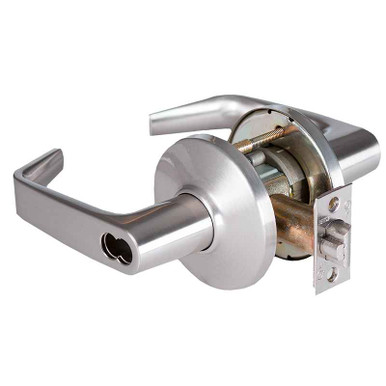
Browse the cylindrical lever locks category for the full function matrix.
Where do cylindrical knob locks still make sense in commercial builds?
Knobs are not ADA-compliant for doors on an accessible route, so their role in modern commercial work is narrow: utility closets, mechanical rooms, back-of-house storage, and any opening the AHJ has cleared as not requiring accessible hardware. The BEST 6K Series is a Grade 2 knob option when the opening genuinely qualifies. For everything else, specify a lever. See the commercial cylindrical knob locks category.
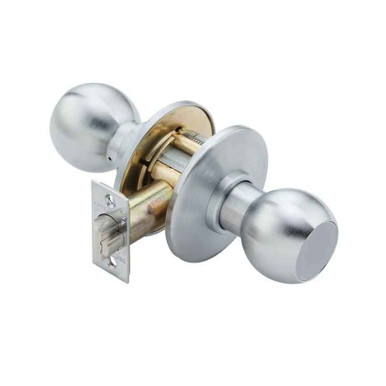
When should I spec an electrified mortise lock instead of an electric strike?

Electrified mortise and electric strike both unlock an opening on command. The decision rule:
- Electrified mortise lock when you want the access-control logic in the lock itself, with secure latchbolt retention and no modification to the frame. The lock monitors latch position, request-to-exit, and door position from one chassis. Use for high-security openings, exterior doors on hollow-metal frames, and any opening where you need request-to-exit and deadbolt status feedback.
- Electric strike when you want to add access control to an existing mechanical lock without replacing it, or when the frame is easier to modify than the door. Lower cost per opening. Use for tenant-improvement work and retrofits.
The Schlage ND-Series electrified cylindrical storeroom lock (fail-secure, electrically unlocked) is the electrified cylindrical counterpart to the ND80PD. The BEST 45HW is the hardwired electromechanical mortise. For strikes, the Adams Rite 7430 Ultraline is the standard for aluminum storefront jambs, with field-selectable fail-safe/fail-secure. See electrified mortise locks and electric strikes for the full catalog.
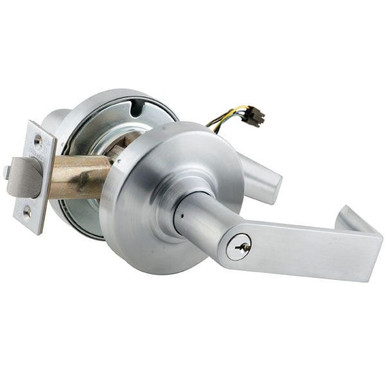
Need commercial locks now? Browse our mechanical locks inventory — Grade 1 Schlage, Sargent, and BEST ready to ship with volume-pricing available on full openings.
Are electronic keypad locks reliable for commercial use?

Standalone electronic keypad locks are production-ready for the applications they're designed for: tenant suites, conference rooms, IT closets, small-office main entries, and any opening that needs code-based access without the cost of networked access control. The BEST 9KZ EZ is the cylindrical standalone with key override; the BEST 45HZ EZ is the mortise version.

Battery life framework for planning: low-traffic openings (under 20 entries/day) will run 3–5 years on 4 AA; medium traffic (20–100/day) 1–2 years; high traffic (100+/day) 6–12 months. Spec networked locks (through the Schlage Electronics CO/LE/NDE/XE360 series) when you need audit trails across many doors, scheduled access, or credential revocation from a dashboard. See electronic keypad locks.
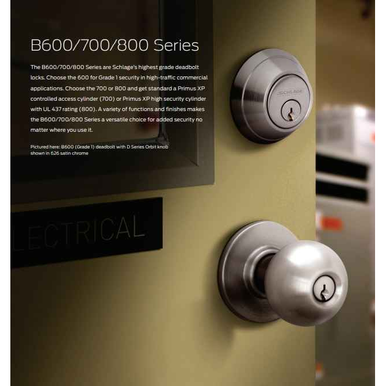
What commercial deadbolt should back up the primary lockset?
Deadbolts aren't rated on the cylindrical standard. A156.5 Grade 1 is 250,000 cycles, Grade 2 is 100,000, Grade 3 is 25,000 — deadbolts cycle far less often than primary locks, which is why the thresholds are lower.
The Schlage B-Series Grade 1 double-cylinder deadbolt is the choice for exterior exit-only doors where code permits (verify against NFPA 101 egress requirements). The Schlage B-Series Grade 1 single-cylinder deadbolt is the choice for most exterior back-of-house doors. For occupancy-indicator applications on restrooms and private offices, the Schlage B-Series Grade 1 single-cylinder deadbolt with OS-OCC/IS-LOC indicator satisfies IBC accessible-restroom indicator requirements. See commercial deadbolts.
What specialty locks do healthcare and behavioral-health openings need?

Behavioral health, detention, and secure patient areas require anti-ligature trim — levers that will not support a cord or strap under load. The BEST SPSL mortise and BEST SPSL cylindrical are the two platforms to specify. Schlage's L9000-series HSLR anti-ligature mortise is the direct cross for institutional mortise specs.
For patient-room and exam-room privacy with a visual indicator of occupancy, the Sargent 11U68 Hospital Privacy is Grade 1 cylindrical with the hospital-style turn.
How do Schlage, Sargent, and BEST commercial locks compare?
Choose Schlage when:
- Spec documents call out the L9050 (mortise) or ND-Series (cylindrical) by name — don't substitute.
- You need the widest commercial trim, finish, and keyway selection on the market.
- The facility already runs on Primus or Everest keyways and you want continuity.
- You want deep inventory across standard functions for fast ship.
Choose Sargent when:
- The spec calls out 8200 mortise or 10-Line / 11-Line cylindrical — Sargent is the Assa Abloy answer to the L9000 and ND.
- You need the T-Zone modular cylindrical platform for a mixed-function opening schedule.
- The facility is standardized on Sargent keyways (Degree, XC, LFIC).
Choose BEST when:
- The facility uses SFIC (small-format interchangeable core) keying — BEST is the native platform.
- In-house locksmith staff will rekey cores without pulling locks off the door.
- You want the 9K cylindrical and 45H mortise on one unified key system.
| Brand / Series | BHMA Grade | Cycle Rating | Best For | List Price Tier |
|---|---|---|---|---|
| Schlage L9082 mortise | Grade 1 (A156.13) | 1,000,000 minimum per A156.13 | Main entries, classrooms, high-traffic institutional openings | High |
| Schlage ND80PD cylindrical | Grade 1 (A156.2) | 800,000 minimum per A156.2 | Offices, interior commercial, tenant suites | Mid |
| Sargent 11G04 T-Zone cylindrical | Grade 1 (A156.2) | 800,000 minimum per A156.2 | Healthcare, higher-ed, modular function planning | Mid |
| BEST 45H mortise | Grade 1 (A156.13) | 1,000,000 minimum per A156.13 | SFIC-keyed facilities, K-12, universities | High |
| BEST 9K cylindrical | Grade 1 (A156.2) | 800,000 minimum per A156.2 | SFIC-keyed interior openings | Mid |
| Adams Rite 7430 electric strike | A156.31 | Per A156.31 electric-strike standard | Aluminum storefront access control | Value |
For fire-rated openings, every lock above is available in a labeled version listed for use in UL 10C-tested fire door assemblies — assembly ratings up to 3 hours depending on door and frame construction. NFPA 80 prohibits mechanical hold-open on fire-rated openings; electromagnetic hold-opens released by the fire alarm are permitted.
Ready to spec? Shop commercial mechanical locks at ZenSupply — Schlage, Sargent, BEST, and Adams Rite in stock across Schlage, Sargent, BEST, and Adams Rite. Request a quote for full-opening pricing.